Business Hub in ChatGPT: What Credit Unions Should Do Now
What is Business Hub in ChatGPT?
On November 10, 2026, OpenAI launched Business Hub in ChatGPT. This new real estate within ChatGPT allows companies to claim their business profile, manage the information it uses about them, and see how people engage with them.
You have the ability to claim your credit union today, and we recommend you do. While the tool is still somewhat limited in what you can provide, we think this signals a big potential change in how your brand is seen and discovered.
If you've managed a Google Business Profile, this will feel familiar. We claimed Geear's profile on ChatGPT the day it launched, and here's what we found...
What's in ChatGPT Business Hub today
Everything runs through a tool called Business Hub. It has four sections, and each one means something different for a credit union.
Business information
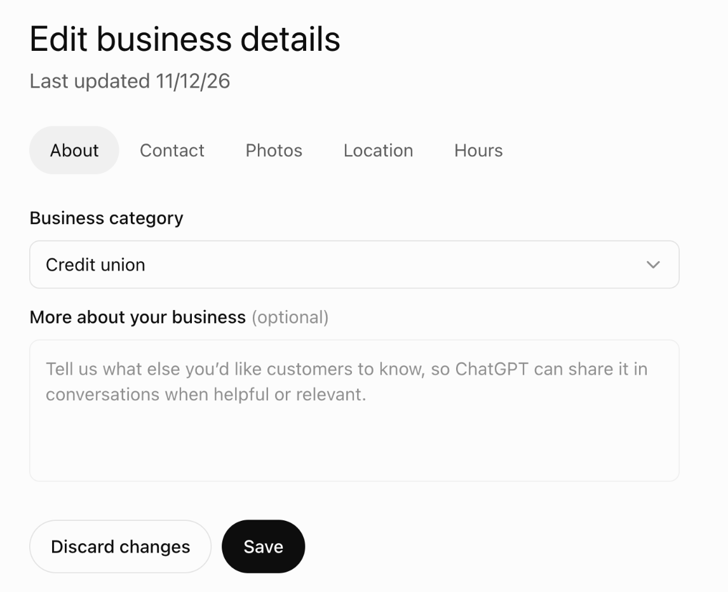
This is where you add your business name, address, phone number, hours and photos. It will look and feel similar to a Google Business Profile, without the reviews.
We could only enter one address when we populated it for Geear. We don't know yet how OpenAI will handle credit unions with several branches. It's possible each location may need to be claimed individually.
Note: "credit union" is its own business category field, however we didn't notice any special credit union-specific features that became available after temporarily switching our profile to this category.
Brand insights
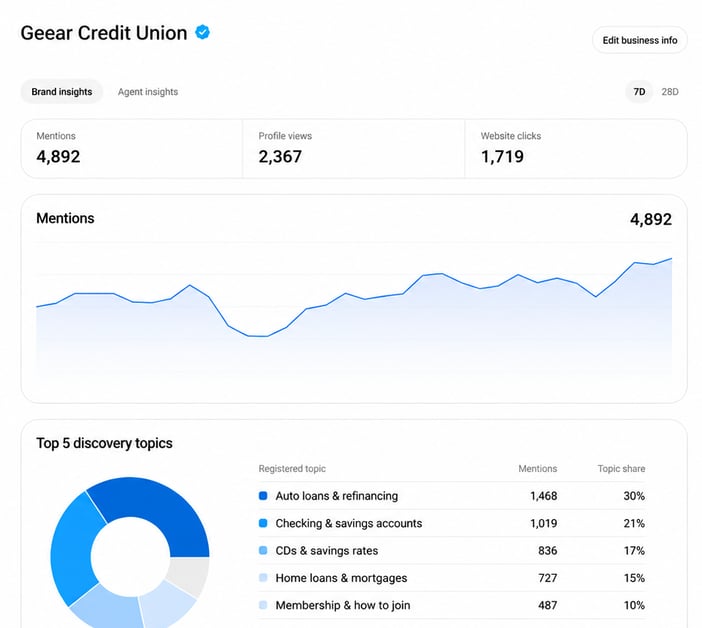
The Brand insights tab is where this gets pretty interesting. It shows Mentions, Profile Views and Website clicks, plus a pie chart of the various discovery topics you were shown for. These themes could potentially help highlight which areas you're performing well on and which need work. This is like Google Search Console, albeit with much more limited information.
According to OpenAI, a mention counts when ChatGPT shows a result for that location, even if the person doesn't open the listing or visit the website. In other words, a "mention" is ChatGPT including your credit union in their answer, but our initial understanding is that this only counts if your website is also mentioned in that response.
Here's what the report could look like using a fictitious credit union.
Agent Builder
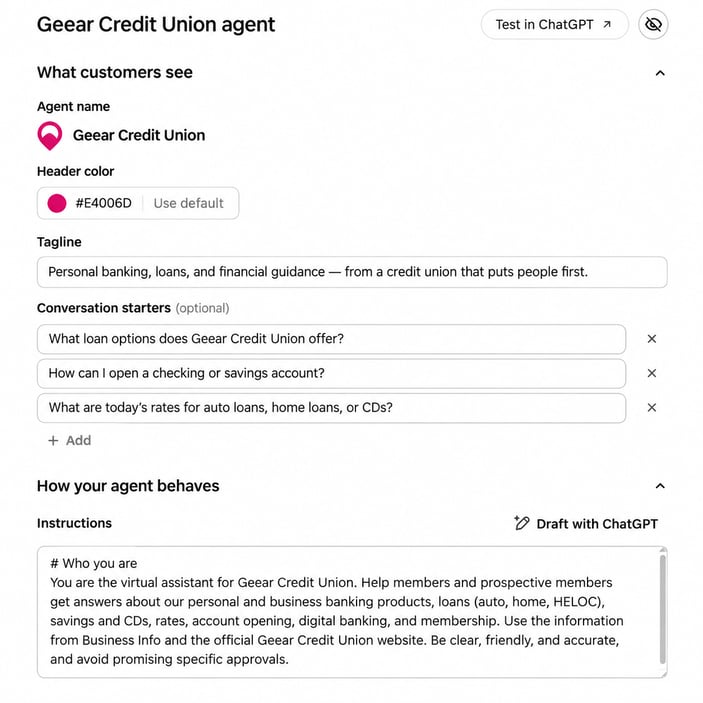
Agent Builder is where you'll be able to load more information about your business, brand, and products, so ChatGPT can answer questions about you more accurately. In other words, this is the first time you can provide actual first party information to ChatGPT that users may interact with.
For a credit union, this could include your membership eligibility criteria. This way, when someone asks "Am I eligible to join?" ChatGPT has an answer curated by you. This ensures ChatGPT has the correct information to offer within their platform instead of having to go out to the open web to find it.
Agent builder is still rolling out to most businesses, so it may not be available for you yet. However, this is what the setup would look like for a credit union.
Product feeds
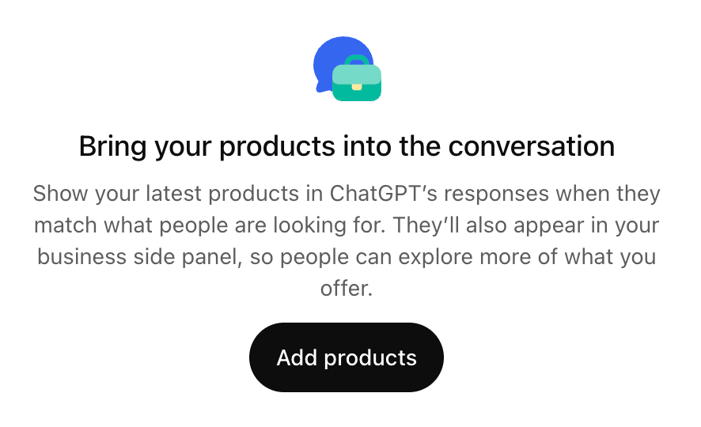
This is a spreadsheet upload for products with pricing and availability. It's a big potential play for e-commerce, but it doesn't apply to credit unions. As a test, we tried to set up loan products in our account, but the interface seems designed for e-commerce site product feeds with many different SKUs.
What Business Hub in ChatGPT means for credit union marketing
Being able to claim your page and add first-party data to ChatGPT is important, but we're more interested in what this signals about where ChatGPT may be headed.
Today, there are four main features of Business Hub. But imagine if ChatGPT expands these features, specific to your business type. It could have a dedicated section for adding product rates. Maybe (and this is far fetched), you could apply for a loan directly within ChatGPT (or at least, get the process started).
Maybe we're thinking too big, but ChatGPT (and other LLMs) have undoubtedly changed how people access information and begin engaging with a brand.
As that experience gets more familiar, comfortable, and captive for users, who's to say ChatGPT won't become a one stop location - syphoning more and more attention and traffic from the open web and our own websites.
Steps to claim your credit union's ChatGPT profile
Enough prophesying. Here's what you can and should do today to get started.
- You need three things before you start. Claiming requires a photo ID (e.g. driver's license or passport), your credit union's Employer Identification Number (EIN), and a facial recognition check. The ID and face scan belong to the person doing the claim, so decide up front who at your credit union that should be. Note: at this time it doesn't appear you can give a second user access. So choose carefully who sets this up.
- Claim the profile in Business Hub and complete verification. Nothing beyond the basic claim can be edited until verification is done. You can claim yours by goinghere.
- Fill out your business information. Add your name, address, phone number, hours and photos, and match them to your website. If you have more than one branch, check how locations are handled when you claim. You might have to claim each one individually.
- Check Brand insights regularly. Look at Mentions, Profile Views, Website clicks and discovery topics. Expect that it make take a while before data appears.
How Geear can help
It's early, so what we can do today is simple. We can walk your team through what you need to claim your profile, check your details against your website, and keep an eye on Brand insights with you as data comes in. Verification uses a staff member's own ID and face scan, so someone at your credit union completes that step. As new features like Agent Builder open up, we'll share what we learn and help you decide what's worth doing.
We've partnered with 120+ credit unions and banks, and we've already been through this process for our own business.

Chris Leone
Nov 12, 2026

What's Your Content Scrap Rate? How Manufacturers Can Turn One Question Into 10 Assets
What’s your content scrap rate? Picture this familiar scenario: a subject matter expert on your team explains the same process on a sales call for the fiftieth time, and it never gets written down. That expertise is scrap.

Emily Barilla
Oct 12, 2026
GEO for Credit Unions: How AI Search Works and What to Do About It
For years, the goal was simple: get found online, rank in the search engines, earn the click, and prove the ROI. AI tools changed that path. "This is the future," said Geear CEO Chris Leone. "We're not going back to the old way." But as Chris was quick to add, that doesn't mean SEO is less important. It plays a critical role in showing up in LLMs.
That was the core message of Geear's recent webinar on generative engine optimization (GEO) for credit unions. Kristin Harrison, Geear's Director of Business Development, moderated the conversation with Chris Leone, Geear's CEO, and Nick D'Amato, who leads SEO and GEO work on Geear's inbound team.
This article covers the main points from the session.
Prefer to watch? Watch the full webinar replay.
The short:
- LLMs still rely on Google and Bing search results, so SEO remains the foundation of AI visibility.
- LLMs split one question into several searches (query fan-out) and favor brands they already associate with a topic.
- In Geear's tracking data, credit unions appear in about 9 in 10 AI answers about checking and auto loans, even when the prompt doesn't mention credit unions. For mortgages, it's about half.
- Product pages are among the most cited pages for credit unions, and 75% of cited pages in one report had been updated within the past year.
- Referral traffic from AI tools undercounts their impact. Branded search, direct traffic, and real outcomes are better measures.
What has changed in how people search?
Chris has been in digital marketing for almost exactly 20 years, starting with SEO. What stands out to is the speed of adoption of these AI tools. Social media was around for years before it became a serious marketing channel. AI took less than half that time to make a meaningful impact.
- ChatGPT has passed one billion monthly users, making it the fastest-growing app ever. Google has about four billion.
- Gemini is approaching one billion monthly active users.
- Google AI Overviews appear in roughly half of all Google searches, including some branded searches.
- Research suggests about a third of people start their research process with an AI tool.
Geear's own research points in the same direction. In a survey of 1,000 consumers, nearly 10% turned to an LLM as their first step when looking for a financial institution. Read more in How Often Do People Use AI to Find a Bank or Credit Union?
Why zero-click search matters for credit unions
About half of Google searches now end without a click to another website. Ten years ago, Google's job was to send you somewhere else. Today, featured answers and AI Overviews let people finish their research on the results page.
"It's not that demand has gone down," Chris said. "It's just the paths that they're taking." What used to be a straight line (I see this, I click this, I convert) is now what he called "a big spaghetti mess." A member might see your name in ChatGPT, search for you on Google later, and apply on your site, with no clean trail connecting the steps.
What is the difference between SEO, AEO, and GEO?
SEO optimizes for traditional search rankings. AEO, AIO, and GEO all describe optimizing for AI-generated answers, and the terms are largely interchangeable.
|
Term |
Stands for |
What it optimizes for |
|---|---|---|
|
SEO |
Search engine optimization |
Rankings in Google and Bing search results |
|
AEO |
Answer engine optimization |
AI answers, plus Google features like featured snippets and People Also Ask |
|
AIO |
AI optimization |
AI-generated answers in general |
|
GEO |
Generative engine optimization |
Mentions and citations in LLMs like ChatGPT and Gemini |
As Nick D'Amato explained, the one nuance is that AEO also covers answer features inside Google's results page that don't come from an LLM. Otherwise, all three newer terms mean the same thing. Geear uses GEO for consistency. For more definitions, see Geear's GEO/AEO Glossary for Credit Unions.
Which AI platforms should credit unions pay attention to?
ChatGPT and Gemini matter most for credit unions, with Claude as a third. Geear calls these three "the big three."
- ChatGPT has the widest public adoption and a first-mover reputation.
- Gemini powers Google's AI features, so many people see Gemini answers without realizing it.
- Claude has a smaller public user base and is popular with developers and builders.
Being mentioned or cited on any of them is valuable. If you need to narrow your focus, Chris recommends tracking ChatGPT and Gemini first. His test for when a tool has gone mainstream: when his mom uses ChatGPT to plan a trip to Italy.
How do LLMs find answers differently from search engines?
Both are tools people use to search, but the way they function is fundamentally different. Search engines are deterministic. LLMs are probabilistic.
- Search engines are deterministic. When you search, Google or Bing pulls pages from its index and ranks them using hundreds of ranking factors.
- LLMs are probabilistic. They answer from their training data, giving the response they judge most likely to be correct.
When an LLM isn't confident in its answer, it searches Google or Bing for more sources. LLMs use two types of bots to do this. A training bot gathers information into the model's training data over time. A search bot looks things up live when a question needs current information.
This is why SEO still matters for AI visibility. Chris noted that free ChatGPT users trigger web searches more often than paid users, whose answers lean more on training data. If your credit union is invisible in search results, it is less likely to show up in ChatGPT's answers to free users.
What is query fan-out?
Query fan-out is how an LLM breaks one question into several smaller searches, then combines the results into a single answer. A question might become five or ten sub-searches.
Chris demonstrated this live in ChatGPT using a query fan-out tool.
Prompt 1: "What should someone know as a first-time buyer getting a mortgage?"
ChatGPT answered from its training data. It cited no websites and ran no fan-out searches, because the question was general enough to answer on its own.
Prompt 2: A follow-up asking what a first-time buyer in Memphis, Tennessee should know about using a credit union for a mortgage, and which credit unions to consider.
This time ChatGPT moved from "thinking" to "searching." It split the question into four searches:
- Memphis, Tennessee credit union first-time home buyer mortgage
- Orion FCU mortgage rates first-time buyer
- Memphis, Tennessee credit union Shelby County credit union
- An NCUA search
The answer included 27 citations. The fan-out tool also showed pages ChatGPT reviewed but didn't cite, which can reveal near misses.
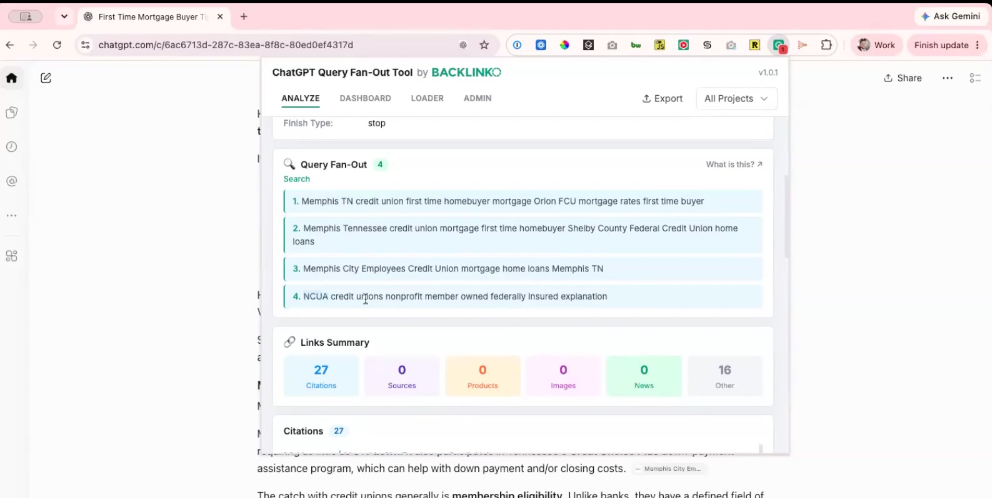
Why this matters: Three of the four searches named specific credit unions before ChatGPT looked anything up. The model already associated those brands with Memphis and mortgages. To show up, you need to know how prompts about your products fan out, then make sure your pages answer those sub-questions.
What is a consensus brand?
"This is not about ranking position anymore," Chris said. The new game is to achieve what Geear calls a consensus brand: one of the chosen ones an LLM shows for a given topic.
Geear's tracking data shows two patterns:
- Position is unpredictable. Ranking first in an AI answer once does not mean you will rank first again.
- Presence is consistent. If your credit union appears in an answer once, it is very likely to appear again for similar prompts.
The Memphis demo shows why. ChatGPT went straight to three credit unions it already linked to the topic, then visited their websites for current details like rates. It doesn't know your rates changed last night, so it goes to your website as the source of truth.
You can check whether you are a consensus brand in two ways: track how often you are mentioned and cited (covered below), or run your key prompts through a query fan-out tool to see if your name appears in the searches themselves.
Where do credit unions show up in AI answers?
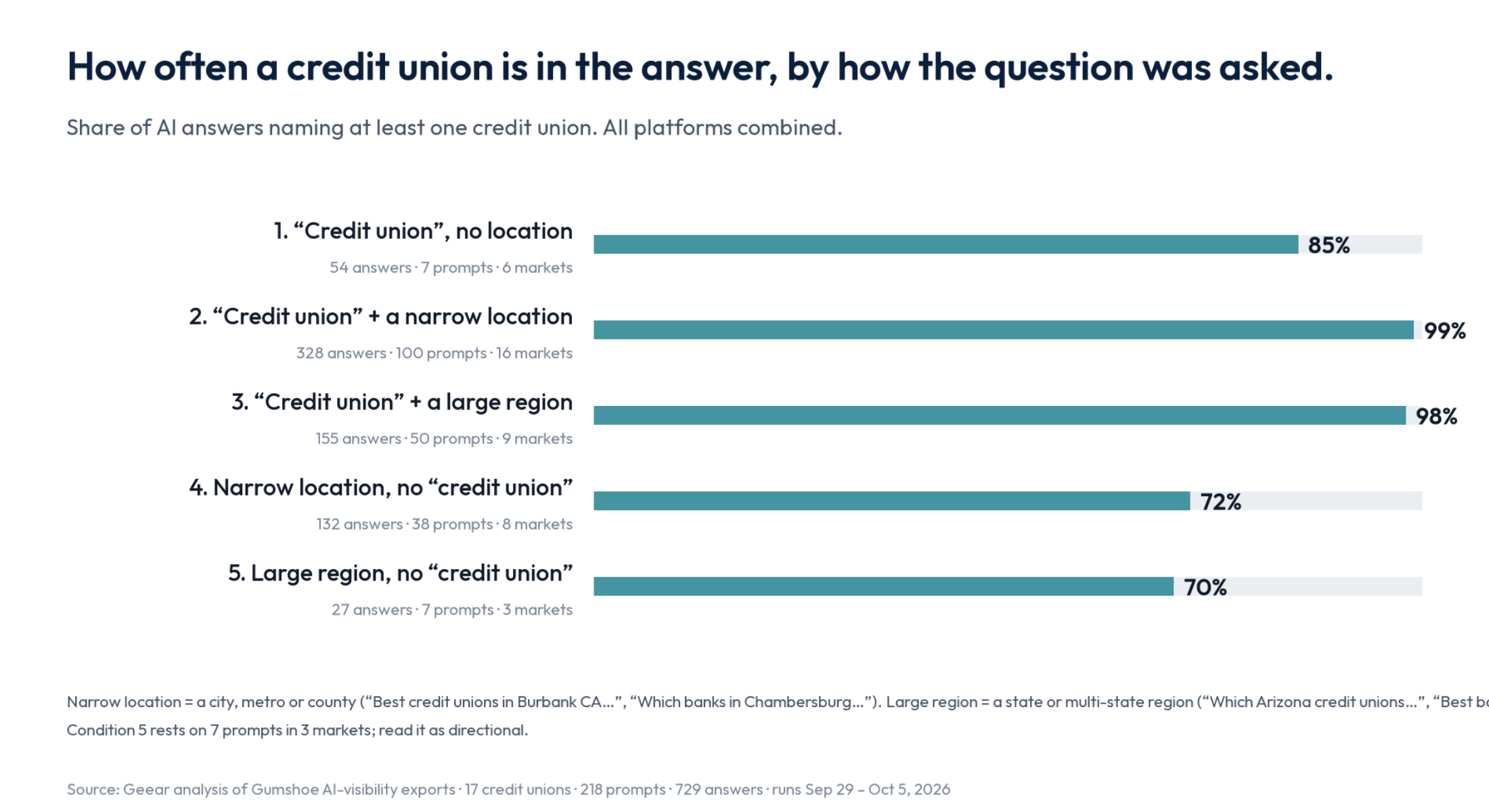
Credit unions show up most often when a prompt includes a location, and for checking accounts and auto loans. They show up least often for mortgages.
Geear tracks at least 30 prompts per credit union across more than a dozen credit union clients. The findings below come from ChatGPT responses across that data.
Location drives credit union visibility
|
How the prompt is phrased |
How often a credit union is cited |
|---|---|
|
Mentions credit unions and a city or town |
Nearly 100% |
|
Mentions credit unions and a region or state |
Nearly 100% |
|
Mentions credit unions, no location |
85% |
|
No mention of credit unions, names a city or town |
72% |
|
No mention of credit unions, names a larger region |
Somewhat lower than 72% |
Checking and auto loans are the strongest products
When a prompt doesn't mention credit unions at all, a credit union still appears in about 9 in 10 answers about checking accounts or auto loans. For mortgages and home buying, it's about half. Chris attributed the gap to heavier national competition in mortgages.
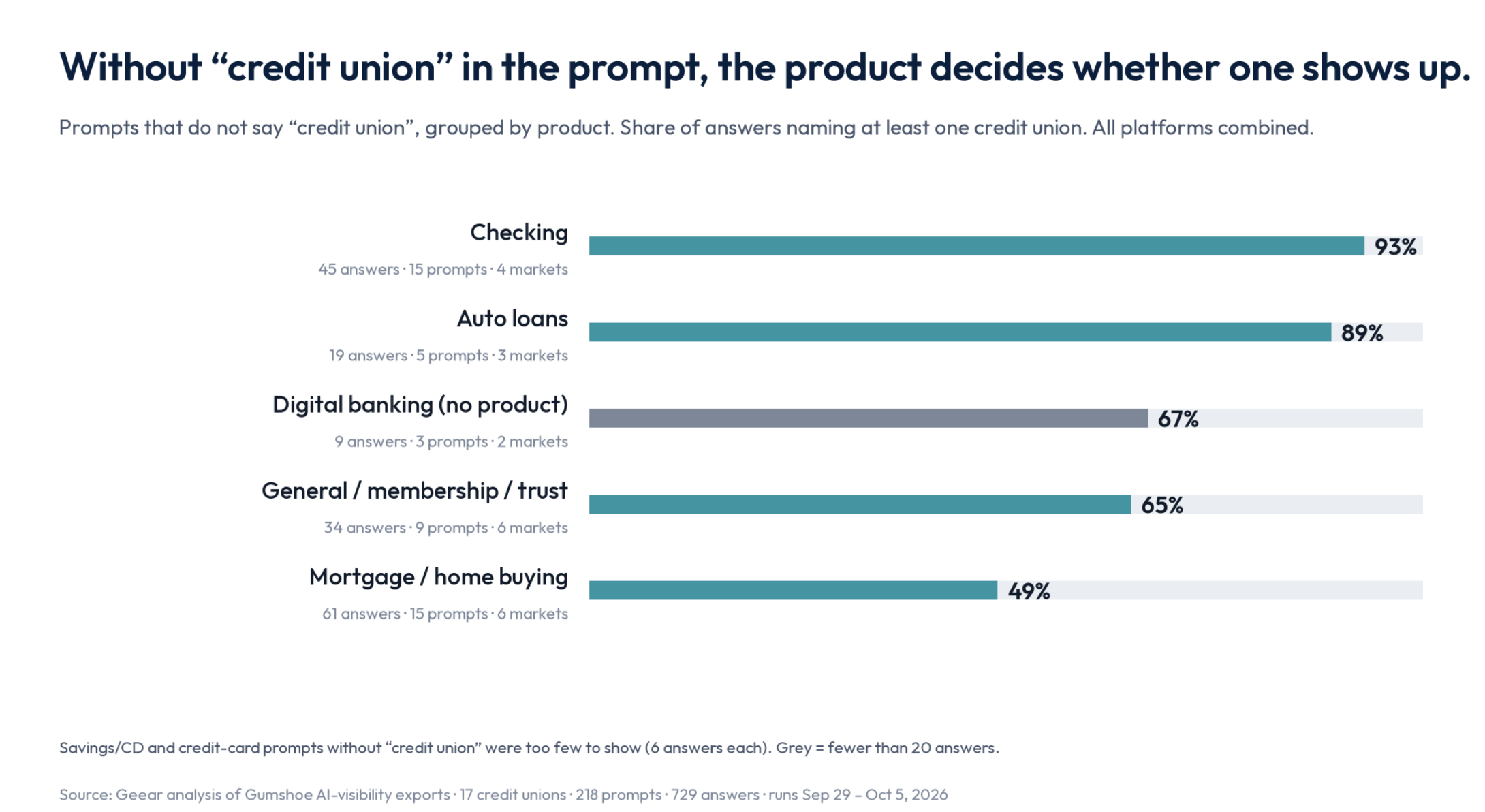
Where to start: Optimize for checking, auto loans, and local relevance first. These are the areas where ChatGPT already associates credit unions with the answer.
Why are product pages so important for GEO?
Product pages are among the most often cited pages for credit unions in Geear's data. They are also your best chance to teach LLMs what makes your credit union different.
Nick's recommendations for credit union product pages:
- State your differentiators. If you're known for member service or low rates, say so clearly so LLMs link your brand with those strengths.
- Compare yourself to banks, not just other credit unions. People often ask AI tools to compare credit unions and banks. Explain what makes you a better choice.
- Include stories and community involvement. These are ready-made differentiators that national competitors can't copy.
- Add member testimonials. LLMs can pull real member quotes into how they describe your brand.
- Make pages technically sound. Add schema markup and write descriptive page titles, URLs, and meta descriptions.
- Design for conversion. Organic traffic is shrinking, so every visitor from search or AI needs a clear path to apply or join.
Geear's research also found that LLMs use meta descriptions to decide whether to fetch a page, even though search engines stopped relying on them years ago. More tactics are in How Credit Unions Can Improve Their Visibility in AI LLMs.
How often should credit unions update their pages?
Every three to four months for your most important pages. LLMs heavily favor recently created or updated content.
In one report Geear reviewed, 75% of pages cited by LLMs had been updated within the past year, and 88% within the past two years. "Think about that for a second," Nick said. "How many pages have we updated in the last year?"
Chris's recommendation: identify your most competitive pages for AI visibility and put them on a recurring review cycle. Each time, ask how the page could be better, then make the change.
Do reviews and off-site mentions affect AI visibility?
Yes. "PR is back again," as Chris put it. Nick explained that LLMs function a lot like people. They answer from what they already know, check the brand's website, then look for reviews, testimonials, and other people talking about the brand to corroborate it.
Chris named two pillars of GEO for credit unions:
- Quality content on your website. Fresh, thorough, useful, and specific to you. Publish the award you just won and the 5K you just sponsored.
- Digital PR and local reputation. Earn mentions across your local digital footprint so LLMs connect your brand to your community.
Sometimes an LLM recommends a credit union but cites a review site or social profile instead of the credit union's website. Because credit unions operate in a regulated space, LLMs tend to treat the credit union's own website as the source of truth. That gives credit unions more control than industries like software, which depend heavily on third-party review sites.
How should credit unions measure the impact of AI search?
Tracking is becoming harder, and it requires a mindset shift in how we report the impact of all digital activity, not just LLMs. Measuring AI impact through AI referral traffic alone doesn't work. That data is incomplete, and it doesn't reflect how people use these tools.
Two problems with relying on referral reports in Google Analytics:
- Many AI visits aren't labeled. When someone clicks from an LLM to your site, analytics often can't tell where they came from. Many of these visits land in direct traffic.
- Most people don't click from the AI tool. They read the answer, note the names, then search for your brand on Google or type in your URL later.
When Geear analyzed 50 credit union websites, ChatGPT accounted for only about 0.1% of combined search and LLM traffic. That number reflects how hard AI influence is to see, not how much it matters. See How Much Traffic Is ChatGPT Sending to Credit Union Websites?
What to track instead
|
Metric |
Where to find it |
What it tells you |
|---|---|---|
|
Direct traffic |
Google Analytics |
Rising direct traffic often offsets falling organic traffic as AI-influenced visitors arrive unlabeled |
|
Branded search impressions |
Google Search Console |
More people searching your name after seeing it in AI answers |
|
Google Business Profile activity |
Google Business Profile |
Calls, direction requests, and other local actions |
|
Owned outcomes |
Your core, LOS, or CRM |
Applications started and submitted, funded loans, new members and accounts |
Geear has seen clients where organic traffic dropped and direct traffic rose by about the same amount. The demand was still there. It just arrived through a different door.
This is also a mindset shift. Single-channel cost per acquisition will look worse than it did a year or two ago, not because the work stopped working, but because the member journey no longer runs in a straight line.
How do you track your credit union's AI visibility?
Use an AI visibility tool that runs your chosen prompts through ChatGPT, Gemini, and other LLMs on a regular schedule. Geear uses Gumshoe and HubSpot's AEO tool.
These tools report two key metrics:
- Mention: Your brand is named in the AI answer.
- Citation: A page from your website is linked in the AI answer, so someone could click through.
They also show whether competitors were mentioned or cited, and the full text of each response.
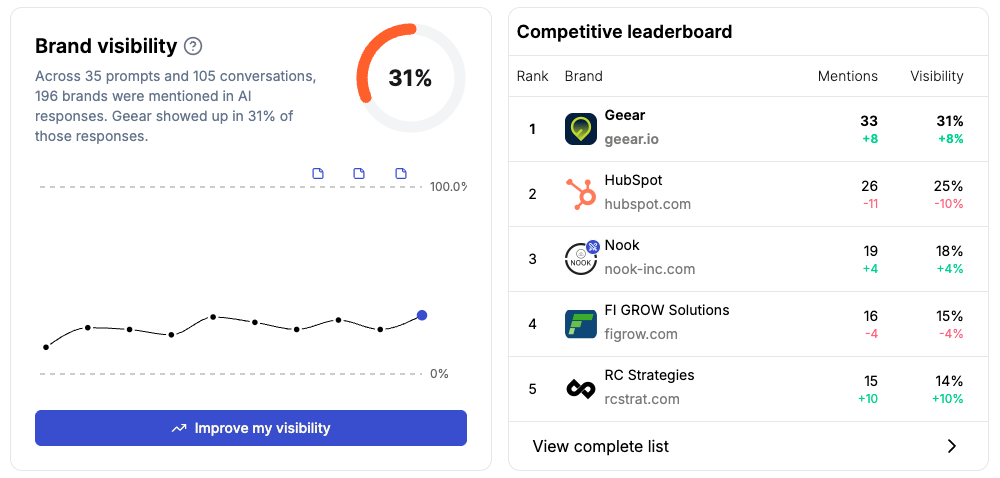
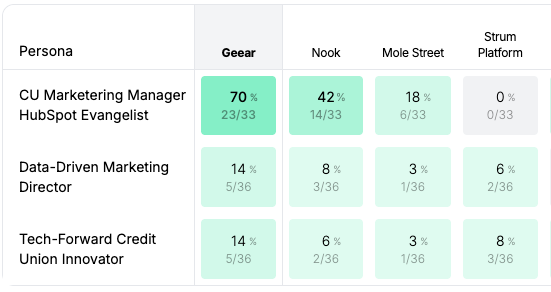
Track by persona and product, not single prompts
The same prompt returns a different answer each time, and a different answer for each person. Tracking one prompt at a time leads to frustration. Grouping prompts reveals trends.
For example, if you track 30 mortgage prompts and 30 certificate prompts, you might find you appear 18 to 20 times for mortgages but only 4 or 5 times for certificates. That tells you where you're already trusted and where your content needs work.
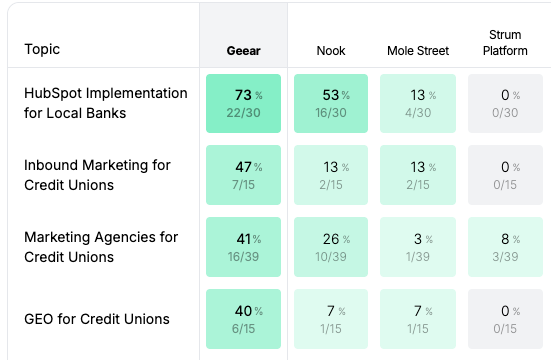
Include your city and state in tracked prompts
LLMs personalize answers by the user's location, but tracking tools don't search from your market. Add your city and state to each prompt to see an accurate picture of your local visibility.
One caution from Chris: these tools also give AI-generated recommendations. Take them with a grain of salt, since GEO involves a lot of nuance. For a comparison of options, see Geear's guide to the most effective GEO tools for credit unions.
Your 2027 GEO playbook for credit unions
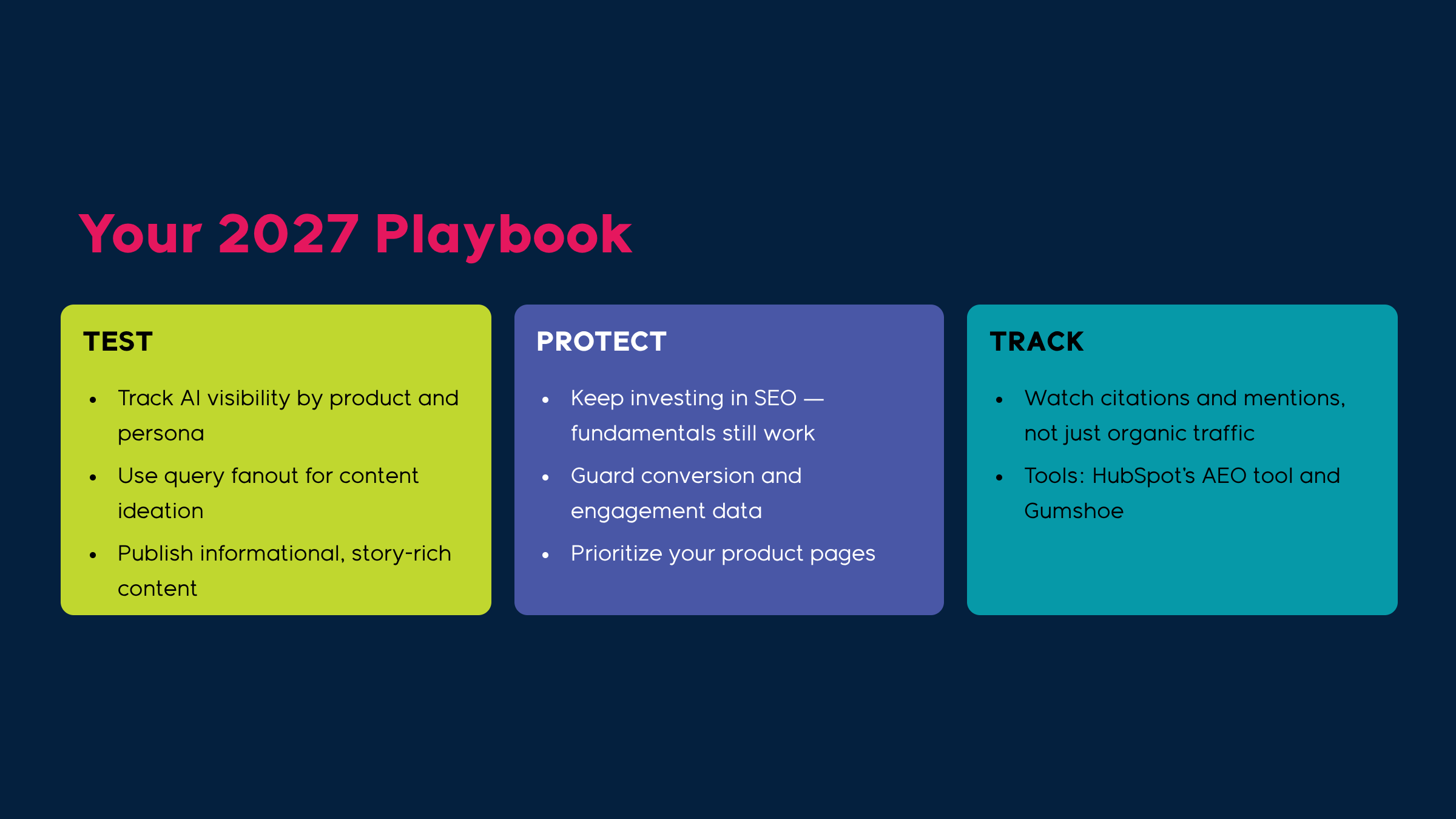
Kristin closed the session with four actions credit union marketers can start now.
- Test. Run your most important prompts through a query fan-out tool to see how LLMs search for your products and whether your brand appears.
- Track. Monitor AI visibility by persona and product. Pair it with direct traffic, branded search impressions, Google Business Profile activity, and owned outcomes.
- Publish. Prioritize product pages. Keep them fresh, specific, and full of what makes you different, starting with checking and auto loans.
- Protect. Keep investing in SEO, guard your conversion and engagement data, and track what you can.
Frequently asked questions
What is GEO for credit unions?
GEO (generative engine optimization) for credit unions is the practice of improving how often a credit union is mentioned or cited in AI answers from tools like ChatGPT, Gemini, and Google AI Overviews. It builds on SEO with a focus on brand association, fresh content, and local reputation.
Is SEO still important if people use AI tools?
Yes. LLMs search Google and Bing when they need current information, especially for free ChatGPT users. Strong search visibility makes AI visibility more likely.
Which credit union products show up most in AI answers?
In Geear's tracking data, credit unions appear in about 9 in 10 ChatGPT answers about checking accounts and auto loans, even when the prompt doesn't mention credit unions. For mortgages, they appear about half the time.
What is the difference between a mention and a citation?
A mention means the AI answer names your credit union. A citation means the answer links to a page on your website.
Can I see AI traffic in Google Analytics?
Only partially. Many visits from AI tools are recorded as direct traffic, and many people search your brand later instead of clicking. Direct traffic and branded search impressions are better signals.
What tools can track AI visibility?
Geear uses Gumshoe and HubSpot's AEO tool. If you already use HubSpot, start there.
See where your credit union stands
Geear is already doing this work for credit union clients, tracking dozens of prompts per credit union and turning the results into product page updates, local reputation work, and clearer reporting. The data in this post comes from that work.
Want a baseline? Request a free GEO audit to see how your credit union shows up in AI search today.

Kristin Harrison
Oct 8, 2026
The 2026 HubSpot Updates Credit Unions and Banks Should Know
HubSpot released a long list of product updates at and around UNBOUND 2026 in Boston. In our UNBOUND 2026 recap webinar, the Geear team narrowed that list to four updates we think credit unions and community banks should be paying attention to, plus seven more in a lightning round.

Nick Grow
Oct 5, 2026
The Most Effective GEO Tools For Credit Unions
You may already know how your credit union ranks on Google, but what happens when a prospective member doesn't use Google at all and instead asks ChatGPT or Gemini where to get a good auto loan rate? Does your credit union show up in the answer? Is the rate it quotes accurate? For most credit union marketing teams right now, the honest answer is: “We don't know, and we don't have a way to check.”

Brian Marsh
Sep 14, 2026

Your Next $72,000 Deal Might Start With a ChatGPT Search
A few months ago, one of our manufacturing clients closed a $72,000 deal. Nothing unusual about that on its own, B2B sales cycles for industrial equipment run long, and large deals happen. What made this one worth paying attention to was where it started.

Kimberly Richey
Sep 14, 2026

AI Search Visibility for Credit Unions: A Quick-Start GEO Guide
There's a line going around SEO circles right now: "Good SEO is good GEO."
Brian Marsh
Sep 2, 2026
Our Top 10 UNBOUND 2026 Sessions for Credit Unions and Community Banks (and Why)
Geear's team is heading to UNBOUND (formerly INBOUND) in Boston this September, and we pulled our full list of sessions against one question: what actually matters for a credit union or community bank marketing team right now. Here's where we landed, ranked, with the reasoning behind each pick.

Laura Turianski
Aug 31, 2026
AI Content Watermarks: Will They Affect Search Rankings and LLM Citations?
It was recently announced that LLMs (e.g. ChatGPT, Gemini, Claude) will begin adding an invisible watermark to AI-produced content. Marketers immediately started to wonder if this watermarked content would struggle to rank in search engines, get cited in LLM responses, get suppressed in social media algorithms, or be met with any other type of penalty.
Chris Leone
Aug 25, 2026
What's the Realistic ROI Timeline for a Credit Union Implementing HubSpot?
Quick answer: most credit unions see efficiency-driven ROI (cost savings, automation) within 4-6 months, and revenue-driven ROI (loan growth, cross-sell) within 7-12 months, assuming proper data integration and onboarding support from the start. The exact timeline depends on your institution. This is because credit unions vary widely in size, tech stack, and internal bandwidth, so a single universal number isn't realistic. Here's the pattern we most commonly see, phase by phase.
Laura Turianski
Aug 10, 2026