
Summarize the points from this blog post with AI




Ever since ChatGPT launched to the public in late 2022, people have been speculating that the days of traditional search engine dominance were numbered.
Almost three years into ChatGPT’s adoption, we’re starting to get an idea of how much websites are actually affected by these new large language model (LLM) tools.
As a digital marketing agency that specializes in credit unions, we wanted to understand the impact these tools are having, specifically on credit union websites. To do that, we pulled data for 50 credit union websites to see how much traffic was coming from ChatGPT compared to traditional search engines like Google and Bing. The purpose of this analysis was to understand how impactful the most popular LLM was in terms of website visits.
What does this mean for CUs?
Over the most recent 90 day period in our study, we tracked about 3.6 million visits across 50 credit union websites coming from Google, Bing, and ChatGPT combined.
Of those visits, roughly 84% came from Google, about 15–16% from Bing, and only around 0.01% from ChatGPT.
Traffic Breakdown (Aug–Oct 2025)
|
Source |
Share of Total Visits |
Approx. Visits |
|
|
84% |
~3,000,000 |
|
Bing |
15–16% |
~575,000 |
|
ChatGPT |
0.01% |
~4,000 |
As shown in the table above, ChatGPT visitors make up just 1/10 of 1% of all visits from Google, Bing, and ChatGPT combined. In actual numbers, that’s only around 4,000 visits across 50 websites in a 90-day span, compared to roughly 3 million visits from Google alone.
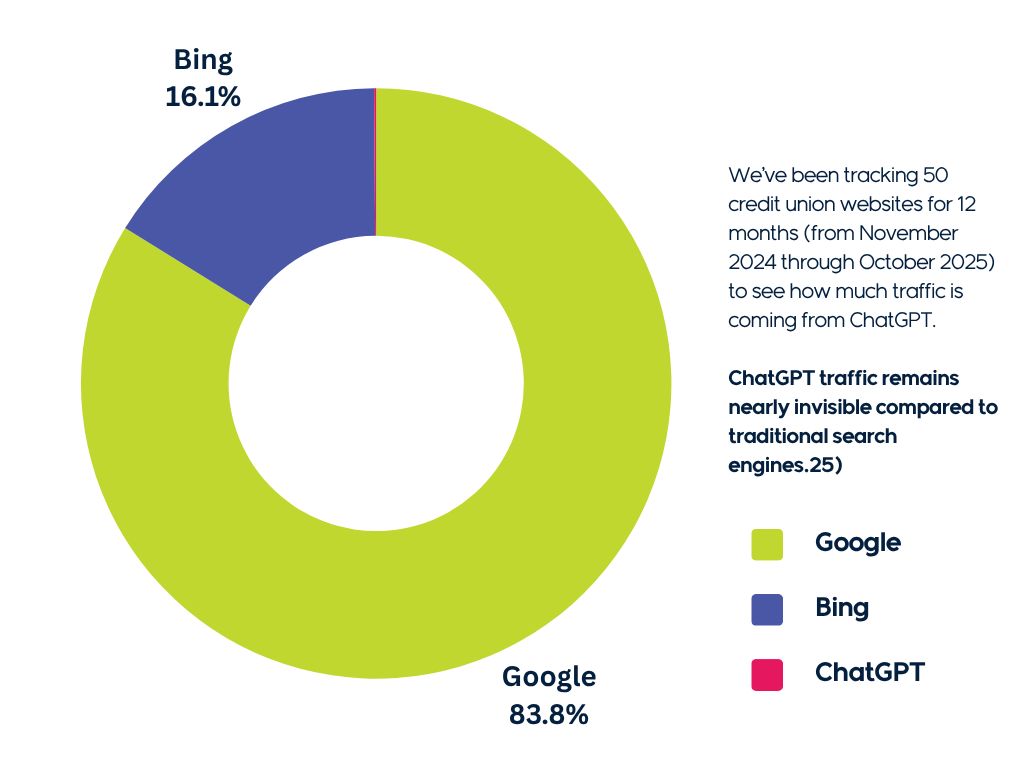
That gap highlights an important point: even as interest and usage of AI tools grow (ChatGPT has seen a 7x increase in usage in over two years), very little of that activity is currently showing up as directly attributable traffic to credit union websites.
To further complicate things, if a visitor is using the desktop or mobile version of an LLM and clicks through to a website, the referral source will get stripped and not properly report in your web analytics. This results in the LLM visitor falling into the 'direct traffic' bucket.
Does This Mean LLMs Are Not Important To Credit Union Marketing?
Low volumes of LLM referral traffic does not mean LLMs don’t play a role in how you’re found. This data simply suggests that traffic from LLMs is not the way to measure their impact on credit unions. The more likely path someone takes to find your credit union that involves AI is to use an LLM for initial research, then move to a search engine to look up the credit union or visit the credit union website directly. This means metrics like branded and direct traffic could be helpful in understanding if LLMs are directing people to your credit union.
What Should Credit Unions Do To Improve and Track LLM Visibility?
Review our latest blog where we dive deeper into what your Credit Union can do to be cited in LLMs.-1.png?width=603&height=352&name=Blog%20Post%20Cover%20Templates%20(5)-1.png)
The AI Hype is Massive. But Traffic Directly from LLM Tools Isn't the Goal.
It’s important to market for today and where the world is going. Fortunately, the most effective sustainable tactics we’ve seen with LLMs involve a strong content marketing and brand-building strategy. We believe that credit unions that continue to build online authority and produce relevant, high-quality content for their members and communities will be set up for success in search engines and LLMs.

 Talk to the Team