Which Credit Unions Show Up in ChatGPT's Answers?
Research
Which Credit Unions Show Up in ChatGPT's Answers
[October 2026 Analysis]
As a digital marketing agency that specializes in helping credit unions grow online, we are deeply curious about how credit unions show up in large language models (LLMs) like ChatGPT, and how we can improve their visibility.
Credit union marketers are wondering the same thing. Understandably, they want their credit union to show up when people are searching for a car loan or looking to open a checking account.
Since the practice of improving LLM visibility (also known as generative engine optimization, or GEO, and answer engine optimization, or AEO) is still so new, we decided to do our own research. Our goal was to figure out where credit unions shine in LLMs and where they are less visible. We then took our research a step further to identify trends and factors that go along with certain credit unions showing up more than others.
This post walks through what we did, what we found, and what you should consider doing to improve your own visibility.
What we did
We ran over 1,500 prompts through ChatGPT, tracked whether or not a credit union was mentioned, and then cross-referenced National Credit Union Administration (NCUA) and Google Reviews data to see which variables go along with higher visibility.
Our prompts were written like the kinds of questions real people ask about their money or future financial products. We ran these prompts in 15 different U.S. markets, including five big metros (e.g. Dallas, Los Angeles and Philadelphia), five mid-size cities (e.g. Chattanooga and Hartford) and five small towns (e.g. Fargo and Manitowoc).
- The questions: there were 34 unique questions spread across checking, savings, certificates of deposit (CDs), auto loans, mortgages, home equity lines of credit (HELOCs), personal loans, credit cards, business accounts, and student accounts. One version of each question (17 in total) explicitly mentioned credit unions ("Best credit unions in Dallas for an auto loan?"). The other 17 did not ("Who has the lowest auto loan rates in Dallas?"). If credit unions want to expand their field of membership, then achieving high visibility in prompts that don't mention credit unions should be the area of focus.
- The volume: we asked every question in every market three times, for 1,530 answers in total. Each was run three times because AI answers can change from one run to the next.
- What we pulled out of each answer: which banks and credit unions were named, the order in which they were named, which websites were linked in the response, and what the answer actually said about each credit union cited.
- What we lined the findings up against: every credit union with a branch in the 15 markets we tested (549 in total) and whether ChatGPT named them. For each credit union, we pulled asset size, membership, and branch locations from NCUA's public data. We pulled their Google rating and review count across every branch (139,800 individual reviews from 1,600 listings). For the pages ChatGPT linked to, we captured the content of that page and details about how it was presented to visitors.
- The model: every question went to OpenAI's API (gpt-5.4-mini with web search on and the user's location set to the market), not the consumer ChatGPT app, so answers can differ from what a person sees in their own account.
1. Credit unions show well for loans but are largely missing from credit cards, mortgages and business banking.
When someone asks about a product without mentioning credit unions, here's how often a credit union shows up:
- Auto loans: 100%
- Savings and CDs, checking, personal loans: 89%
- HELOCs: 84%
- Student and first accounts: 67%
- Mortgages: 43%
- Business checking: 20%
- Credit cards: 13%
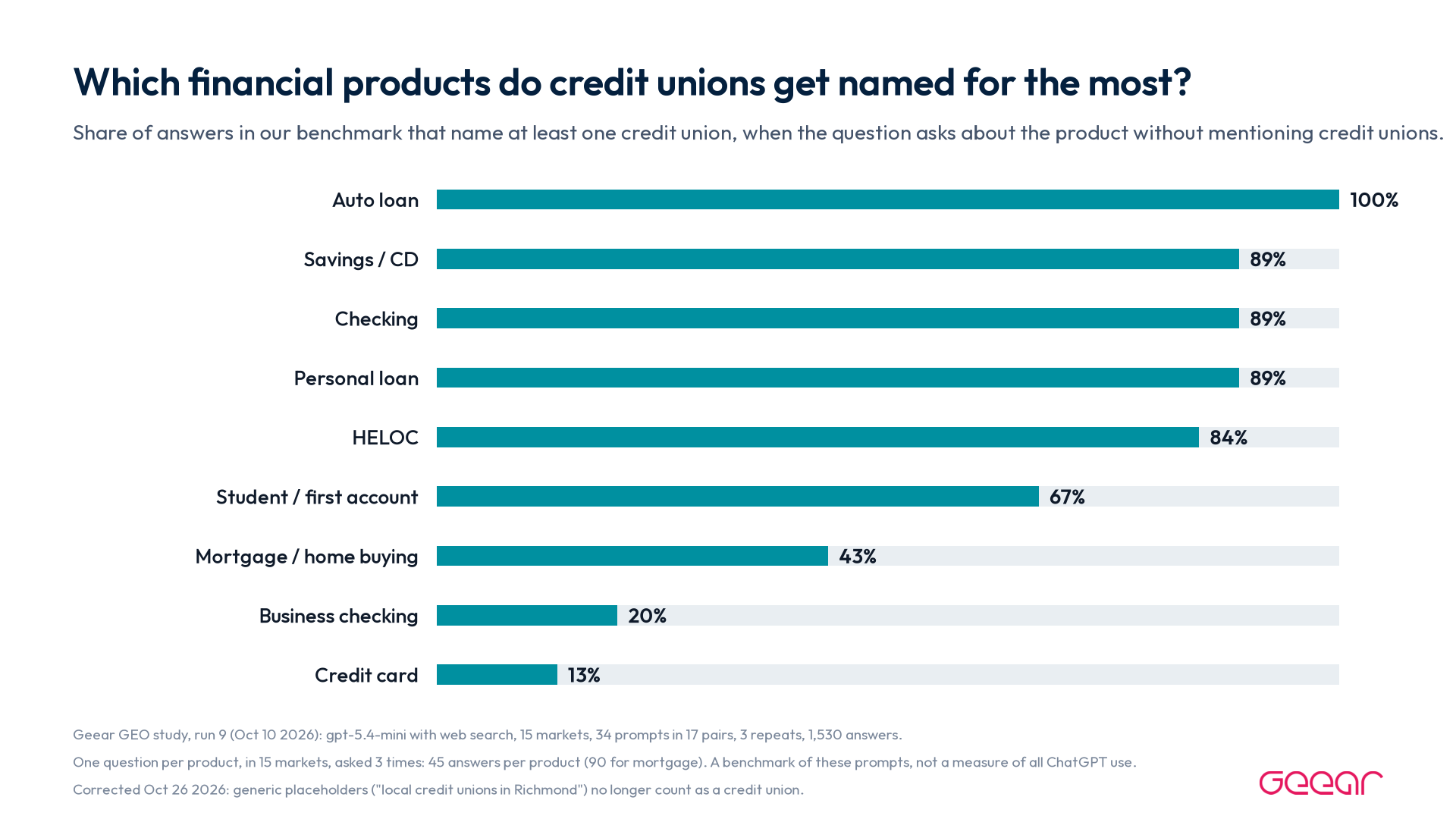
ChatGPT treats credit unions as the default answer for the products credit unions are already known for. The gap is in credit cards, business banking and mortgages, where national banks, card issuers and government housing programs perform much better.
One caveat: when the question does include "credit union," a credit union shows up 98% to 100% of the time for every product. So ChatGPT knows credit unions offer these products. The person just has to ask for a credit union in their prompt. When they don't, other institutions may take the top spots, depending on the product.
In earlier rounds of testing, we also found that prompts tied to a "life moment" (a new job, a move, a new baby, retiring) cited a credit union only about 1 in 9 times. People asking about rates and products get pointed to credit unions. People asking for life advice mostly don't.
2. ChatGPT links to your product pages more than any other page.
Across 3,345 links to credit union websites in AI answers, here's where ChatGPT sent people:
- Product pages: 47%
- Rates pages: 10%
- Locations and branch pages: 9%
- Membership and "how to join" pages: 8%
- Homepages: 8%
- Blogs and learning centers: 5%
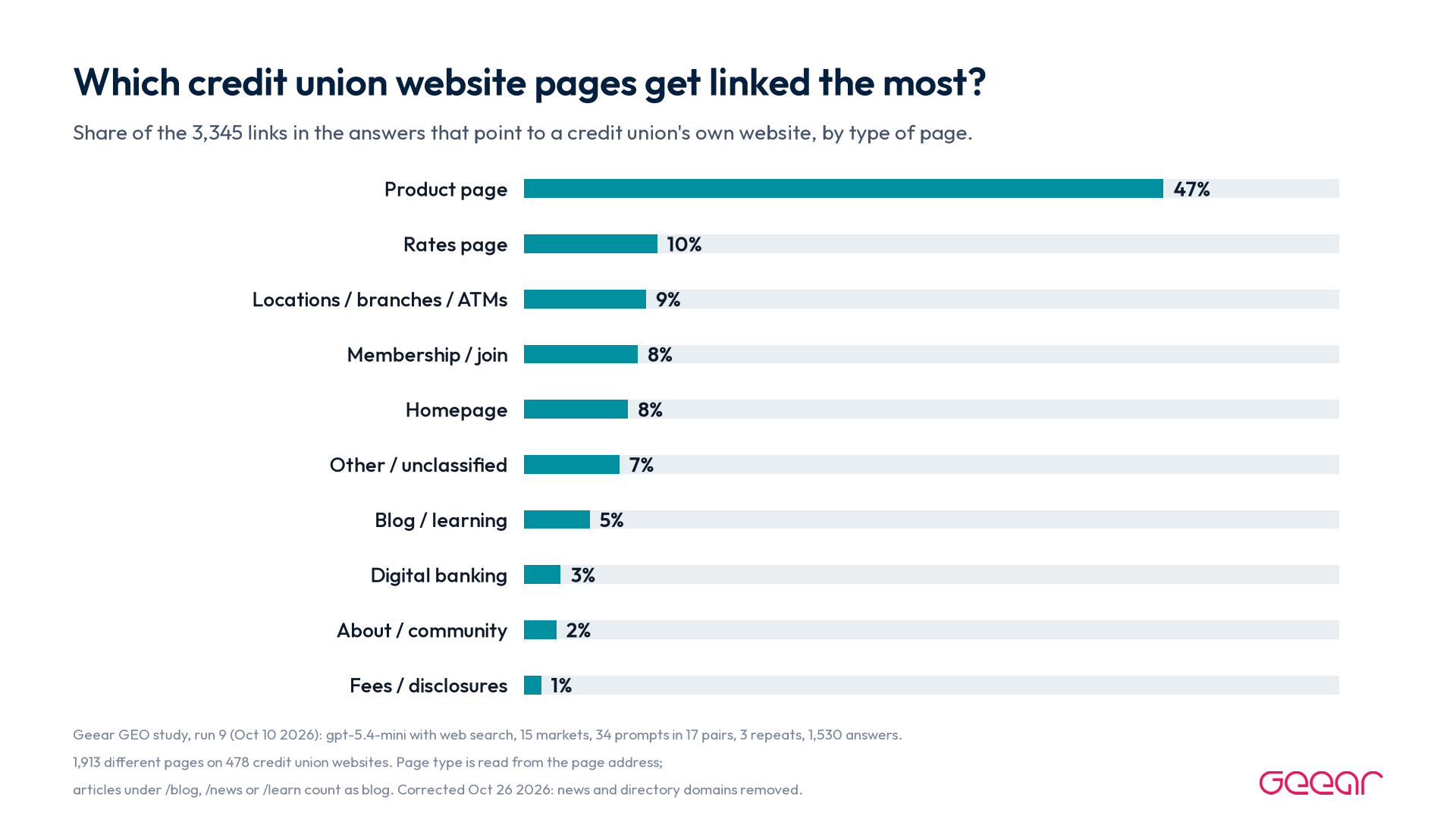
For AI search, a credit union's product page is the most likely front door. Rates pages do well for auto loans, personal loans and savings, but for checking, HELOCs and mortgages the rate needs to be on the product page itself.
We also looked at what the cited pages contained that other pages on the same credit union's site did not. Two things stood out: the cited page named the city used in the prompt, and it stated an actual rate with an annual percentage rate (APR) or annual percentage yield (APY). Cited pages named the city 45% of the time, compared with 25% for similar uncited pages.
3. What ChatGPT says about your credit union depends on the product.
We extracted every fact (4,374 in total) ChatGPT included when mentioning a credit union and sorted them into categories by keyword.
Rates came up most (41% of mentions), then local presence and service area (30%), branches and ATMs (23%), fees and minimum balances (21%), product details (21%) and who can join (20%). Ratings and reviews came up only 9% of the time.
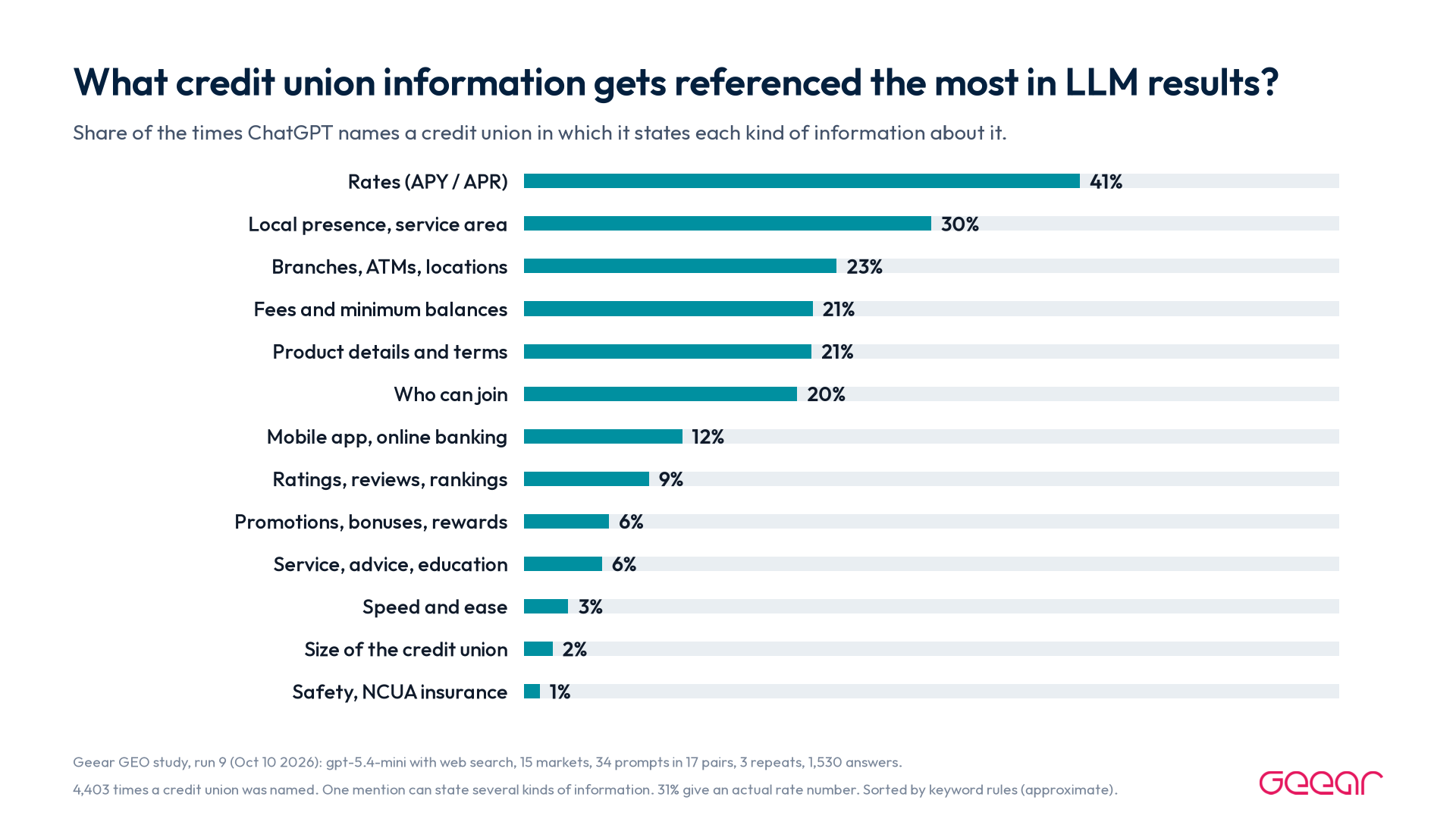
This mix changes meaningfully by product.
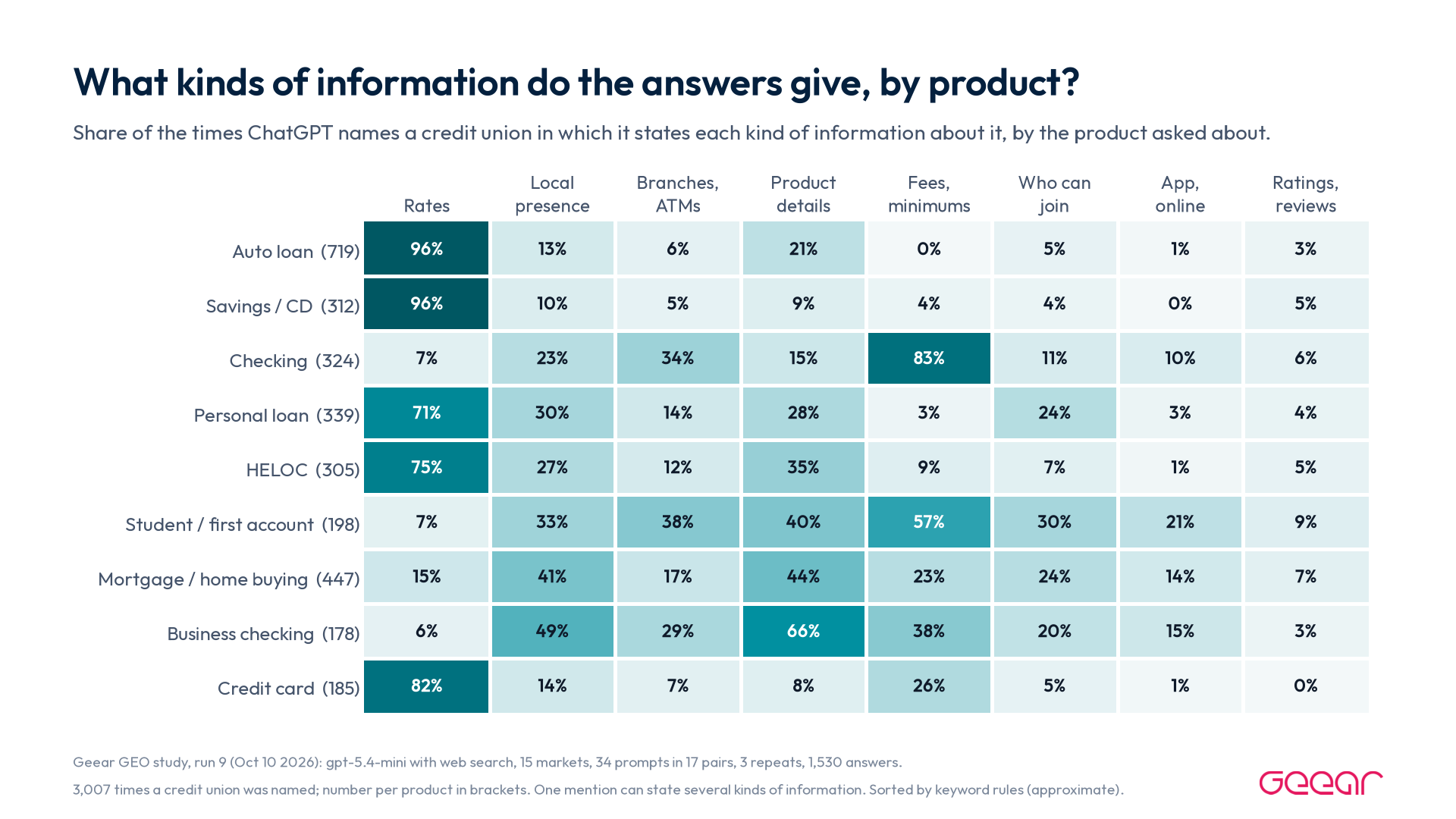
Think of it as ChatGPT showing you what it prefers to include in a recommendation. If your auto loan page lacks a rate, it can't quote one. If your checking page doesn't clearly show the fees, it might look for a credit union that does.
The credit union ChatGPT names first also tends to be described in more detail. Branches and ATMs show up in 37% of first-place mentions, compared with 12% for credit unions cited fourth or lower. Fees are mentioned 29% of the time for first-cited credit unions and 13% for lower-cited ones.
4. Size, proximity, and reviews relate to how often a credit union is named.
Of the 549 credit unions in the markets we tested, we wanted to know which ones ChatGPT names when someone doesn't include "credit union" in their prompt.
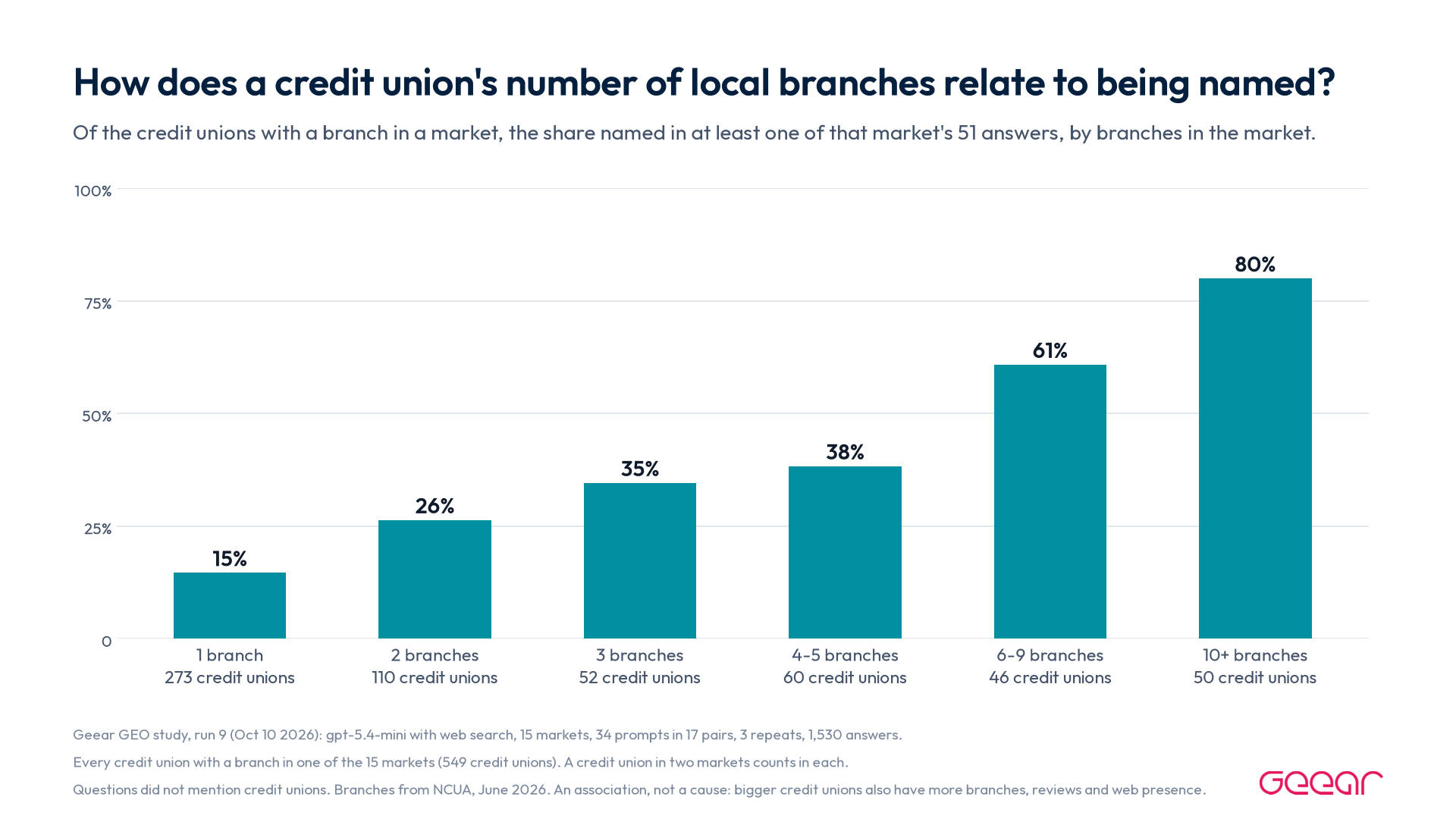
Having multiple branches in the market matters a lot. Credit unions with one branch in a market were named at least once 15% of the time. Two branches: 26%. Three branches: 35%. Four or five branches: 38%. Six to nine branches: 61%. Ten or more: 80%.
Size matters too. Credit unions over $5 billion in assets were named at least once in their market 75% of the time. Those under $50 million were named 15% of the time.
A local headquarters helps, and you don't have to be big to win your own town. Some of the most cited credit unions in our study were under $500 million in assets and headquartered in the market they lead.
Google review count lined up with visibility. Surprisingly, Google star rating didn't.
- Credit unions with under 25 reviews were cited 25% of the time. Those with 100 to 499 reviews were cited 44% of the time. Credit unions with 2,000 or more reviews were cited 89% of the time.
- Star rating showed no clear pattern. Among credit unions with at least 25 reviews, every rating band below 4.8 stars landed between 43% and 50%, and the 4.8+ group came in lower at 33% (that group is only 24 credit unions).
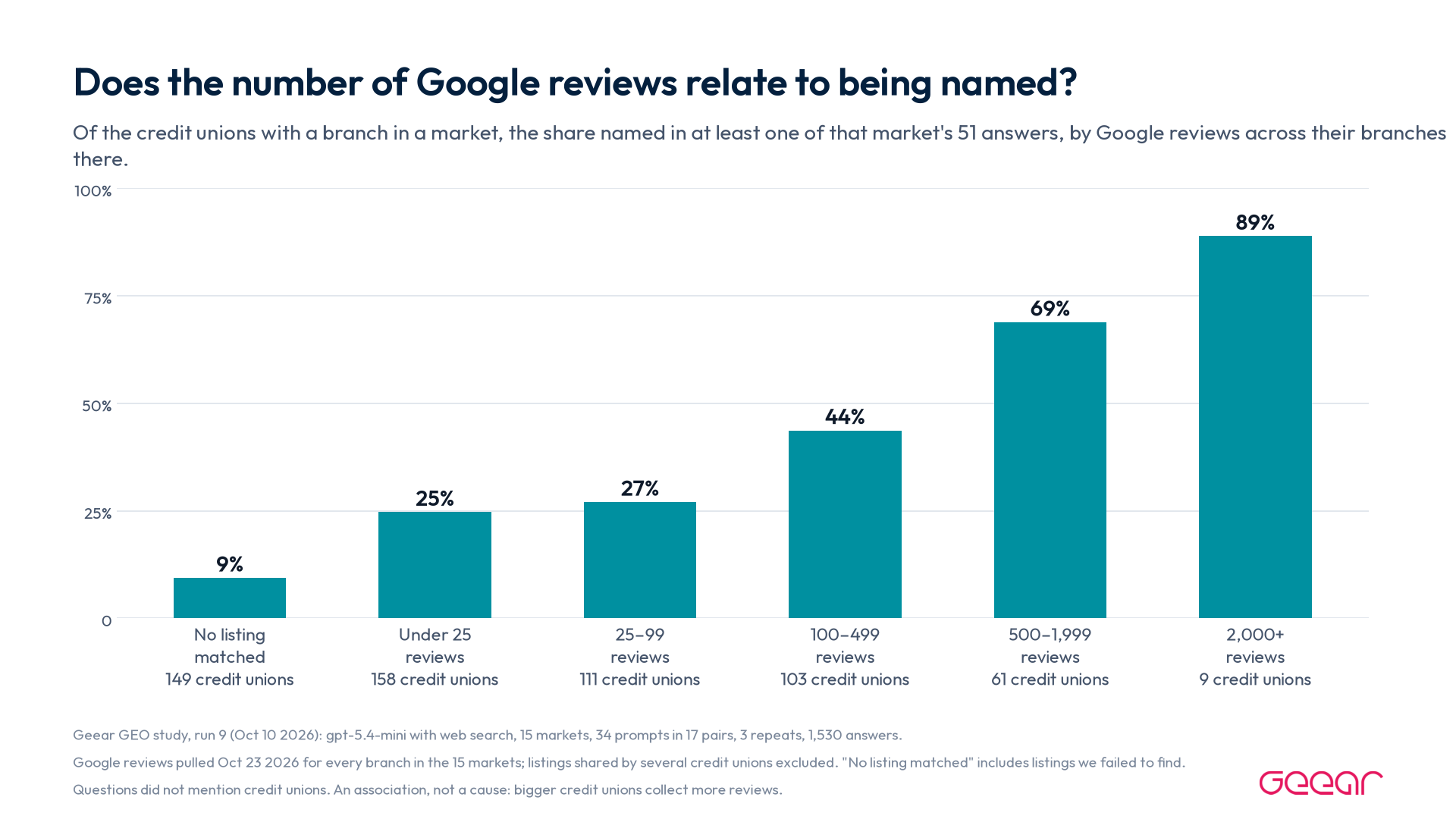
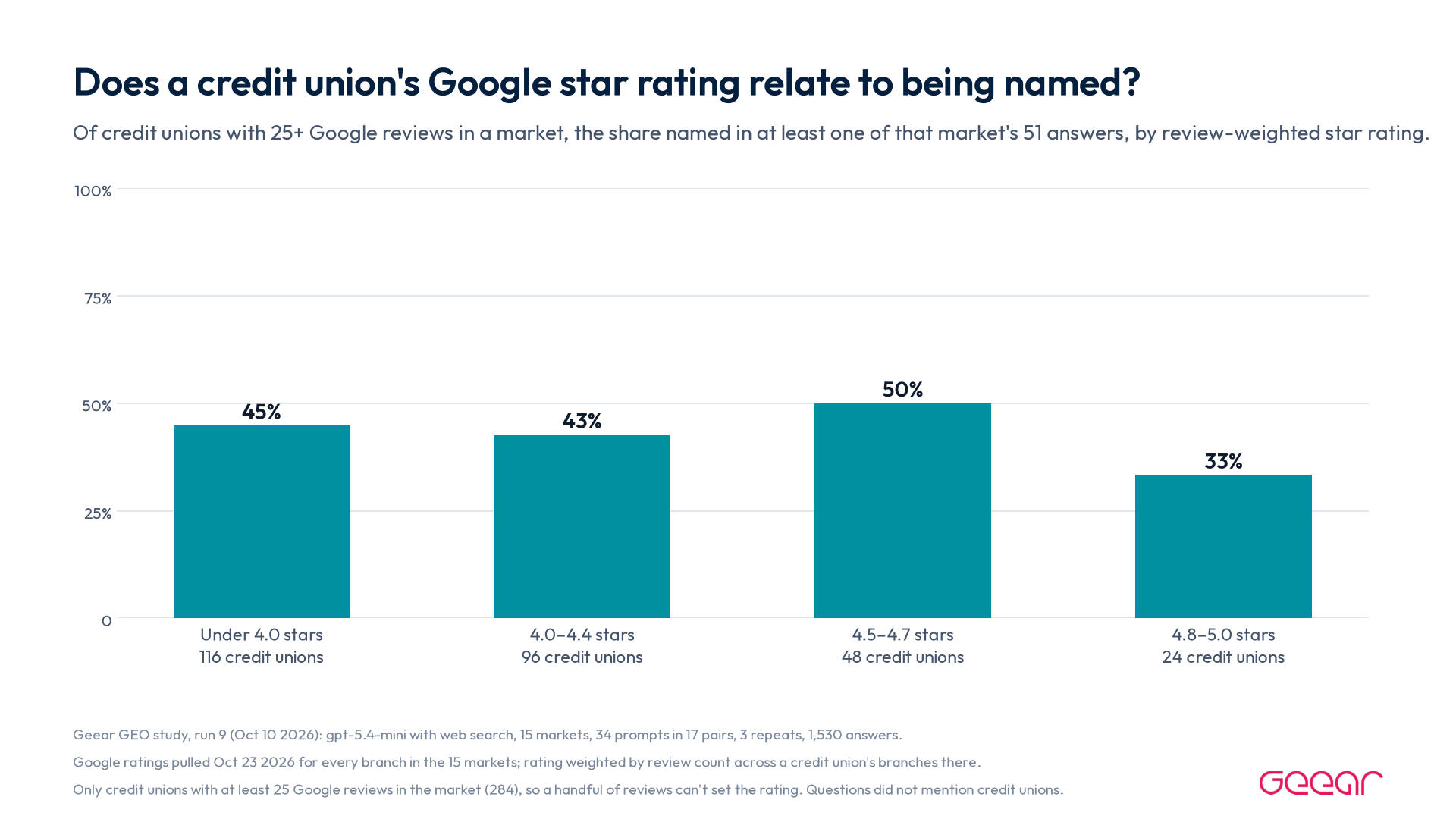
Bigger credit unions naturally have more branches and likely more reviews. To account for that, we compared credit unions of similar size, branch count and market size. Review count still held as one of the strongest signals in the study (roughly as strong as asset size). Star rating still did not matter.
ChatGPT almost never mentions Google reviews in its answers (e.g. "XYZ Credit Union has 4.7 out of 5 stars"), yet having more reviews lines up with higher visibility. Our suspicion is that review volume reflects how much real-world footprint and attention a credit union has in its market, and that footprint shows up everywhere ChatGPT looks.
How we counted reviews: we looked up every NCUA branch and office on Google, so each branch is its own Google Business listing, and added up the reviews across a credit union's listings within each market. A credit union's count in one market reflects only its branches in that market. Star ratings were weighted by review count across those same listings.
5. Rates in tables vs. text made no detectable difference. Having the rate on the page did.
We tested whether the way rates are presented affects a credit union's visibility in ChatGPT. We pulled about 1,100 credit union product pages, some that ChatGPT linked to and some from the same websites that it didn't, and looked at exactly how each one presented its rates.
Table or text made no difference. The first rate sat in a table on 25% of the linked pages and 25% of the others. Whether APR or APY was printed right next to the number didn't separate them either.
What mattered was whether there was a rate on the page at all. 59% of the product pages ChatGPT linked to showed a rate, compared with 45% of the ones it didn't link to. On auto loan pages the gap was 81% vs. 51%. On savings and CD pages it was 69% vs. 49%.
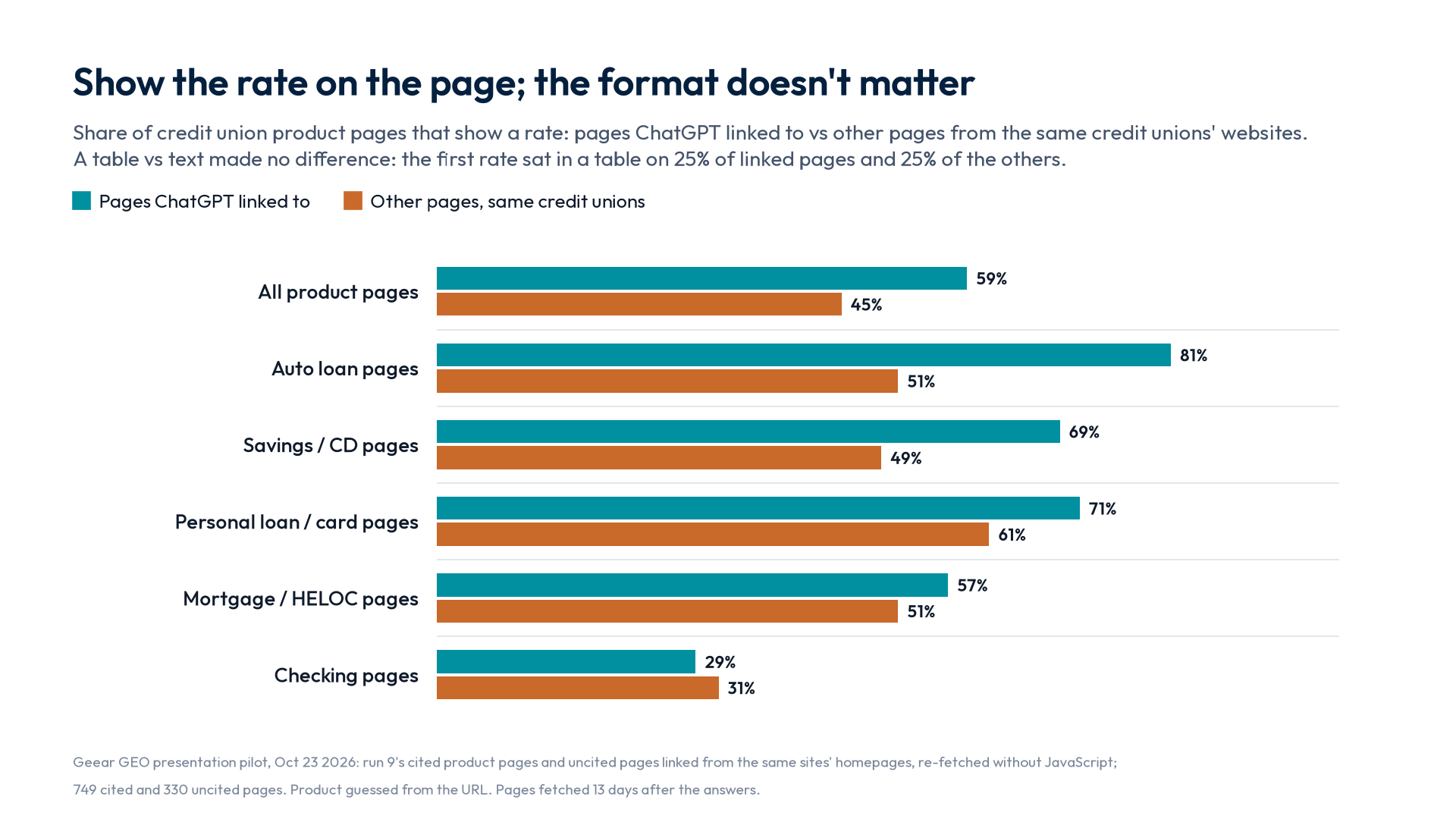
We found no sign that format matters, so focus on making sure the number is on the page itself and not hidden behind a "see rates" link or loaded in a way a search tool may not be able to read. A rate widget or feed from a third-party provider, rates built by JavaScript after the page loads, rates in a PDF, or rates in an image may not be readable.
What to focus on
Based on the research above, here's what we recommend to improve your visibility in ChatGPT:
- Treat product pages as your website's front door. Every major product should have its own page that speaks to who it's for, the area you serve, and other relevant details.
- Put the actual rate on the page. Include the APR or APY, the term, conditions, and a clearly visible "rates as of" date. Rates that look outdated could be devalued (our research did not specifically reveal this, however LLMs generally show a preference for "newer" page content).
- Clearly define fees and conditions on your checking products. Language like "No monthly fee with direct deposit" is the type of thing ChatGPT quotes in its answers.
- Say where you are. Name the cities and counties you serve on your product pages, not only your locations page. List your branches, and say plainly who can join your credit union.
- Grow your Google review count. A steady stream of honest reviews across every branch is a reasonable strategy, even if it lowers your overall score. Review volume lined up with being named, and we couldn't detect a pattern in the rating.
- Know which products are hard to show up for. Credit cards, business banking, and home-buying prompts are where credit unions rarely appear unless someone specifically asks for one.
What this data represents and what it doesn't
- These results are for one AI model. We tested ChatGPT with web search turned on, through OpenAI's API (gpt-5.4-mini), not OpenAI's consumer app. Gemini, Perplexity and Google's AI answers may show different preferences, and we plan to include them in future scans. Given ChatGPT's popularity, we chose to start with one of its models.
- This research is a snapshot of one moment in time. AI answers will likely shift as models change. We're running the full study again soon to see which trends hold and which shift.
- Our analysis shows patterns. It doesn't prove cause and effect. A credit union with lots of reviews and lots of branches is likely doing a lot of other things well too.
- Just because something isn't cited doesn't mean it isn't a factor. Reviews are rarely mentioned in a ChatGPT response, but having more of them lines up with more visibility. The same could be true for other parts of a credit union website (e.g. a blog), so don't be quick to write something off because it isn't quoted in an LLM response.
Next steps
We plan to repeat this study and expand it across other AI models to see how results vary.
If you want to see how your own credit union shows up in ChatGPT, reach out to our team.
About Geear
We are a performance marketing agency helping community-based financial institutions punch above their weight.
✅ Partnered with over 120 Credit Unions & Banks
✅ HubSpot Diamond Partner
✅ 45 team members strong
✅ SOC2 Type II Compliant

Speak to our team
Interested in finding out how the team at Geear can help your credit union show up in AI answers? Contact us below.

Ready for marketing that actually delivers?
Let's build something measurable together.
 Talk to the Team