
Summarize the points from this blog post with AI




Picture this. A loan officer wraps up a call with a member who's been with the credit union for six years. She has a checking account, a savings account, and a personal loan she's been paying on time for 18 months. The call was about a routing number. It lasted four minutes. The loan officer said goodbye, closed the tab, and moved on.
Nobody mentioned the auto loan rate. Nobody asked if she was thinking about a car. Nobody flagged that members with her exact product profile, two years into a personal loan, steady deposits, no auto product, take out auto loans at the credit union at twice the rate of the general member base.
Why not? Because nothing in front of that loan officer connected those dots. The data existed. The insight didn't.
That's the Next-Best-Product problem. The problem is the gap between the data a credit union holds and the moment when someone can actually act on it.
Where it breaks down
Most credit unions we work with have already made some version of this investment. They have a CRM. They have a marketing platform. They have data coming out of their core. And they still can't answer the question: what should we offer this member today?
The reason is usually one of three things and often all three at once.
The product data isn't structured for reasoning. A member record with a checkbox that says "has auto loan: yes" isn't enough. What's essential is knowing when they took it out, the rate, the maturity date, and other related attributes. Without these, there's no basis for meaningful recommendations. We focus on whether data is organized in a way that enables actionable insights, not just its existence.
The insight lives somewhere the team doesn't. Even when credit unions have invested in analytics, the output tends to live in a report, a dashboard, or a separate tool that someone has to remember to open. That's not how member conversations work. A loan officer doesn't pause a call to pull a report. A service rep handling an inbound doesn't switch screens to check a dashboard. The recommendation needs to be where the work already happens on the member record, visible the moment someone opens it, without any extra steps.
The scoring doesn't reflect what the credit union is actually trying to grow. A recommendation engine that just surfaces the most statistically common next product is giving you obvious answers. If a member doesn't have a checking account, recommend one. A useful scoring approach layers in the credit union's own strategic priorities. Trying to grow auto loan volume this quarter? Trying to build deposit relationships? The logic should weight accordingly, so the recommendation isn't just about the member, it's about the right intersection of member fit and institutional goals.
What the right setup actually looks like
When these three things are working, here's what changes in practice.
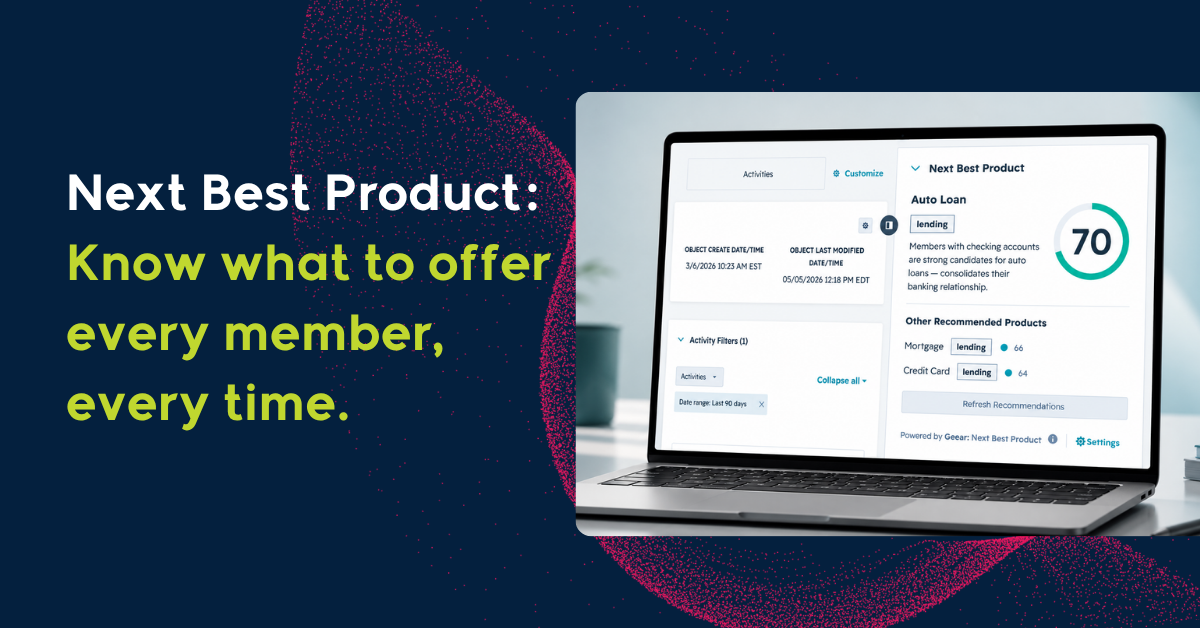
The loan officer who took that four-minute call would have immediately seen, in the CRM, that this member is a strong auto loan candidate. This is scored based on her product profile, payment history, and the credit union's current lending goals. One line. No extra steps. It provides a clear signal that a relevant conversation is ready to happen.
The marketing team running their next campaign doesn't pull a generic list of members without auto loans. They pull a scored list, members ranked by how likely they are to respond and how well they fit the current strategic priority. They can then build the campaign around that.
The member service rep who gets a call about a CD maturity date sees a prompt on screen that the member's rate is now below market and that there's a relevant renewal offer worth mentioning. The conversation that was going to be transactional becomes one that actually serves the member.
None of this is theoretical. It's what happens when product data is structured correctly, scoring logic reflects real goals, and the output lives inside the tools teams already use, not alongside them.
The one thing worth doing first
If you're a credit union that's been circling the Next Best Product conversation without landing anywhere, the most useful thing you can do before evaluating any tool or building any model is this: audit how your product data is actually stored in your CRM.
Not whether it exists, it almost certainly does in some form. But whether it's stored as structured objects with meaningful attributes, or as a flat list of checkboxes on a member record. That distinction determines whether any recommendation approach can work at all. It's the foundation everything else is built on, and it's the thing most credit unions skip straight past on the way to the more interesting conversation about technology.
Get that right, and the rest becomes much more tractable. Skip it, and you'll be back in the strategy meeting in 12 months having the same conversation.
See if your data is ready.
The Next Best Product App for HubSpot is now in early access with a select group of credit unions. If the gap described above sounds familiar, the first step is a short conversation. Join the waitlist and a member of our team will be in touch.

Ready for marketing that actually delivers?
Let's build something measurable together.
 Talk to the Team