
Summarize the points from this blog post with AI




You may already know how your credit union ranks on Google, but what happens when a prospective member doesn't use Google at all and instead asks ChatGPT or Gemini where to get a good auto loan rate? Does your credit union show up in the answer? Is the rate it quotes accurate? For most credit union marketing teams right now, the honest answer is: “We don't know, and we don't have a way to check.”
GEO tools are built to fix that blind spot, and at Geear we have tested many GEO tools with real credit union scenarios, and three have risen to the top for us. Each one has its own particular strengths. Our favorite 3 tools are:
- Gumshoe, for how granular it gets on persona and location
- HubSpot's AEO tool, for tying AI visibility to CRM data you're already collecting
- Semrush's AI Visibility Toolkit, for catching Google AI Mode specifically, which most competing tools still miss entirely
Here's the rundown on each of them, including how they shine and areas that could improve as the products get updated over time:
1. Gumshoe
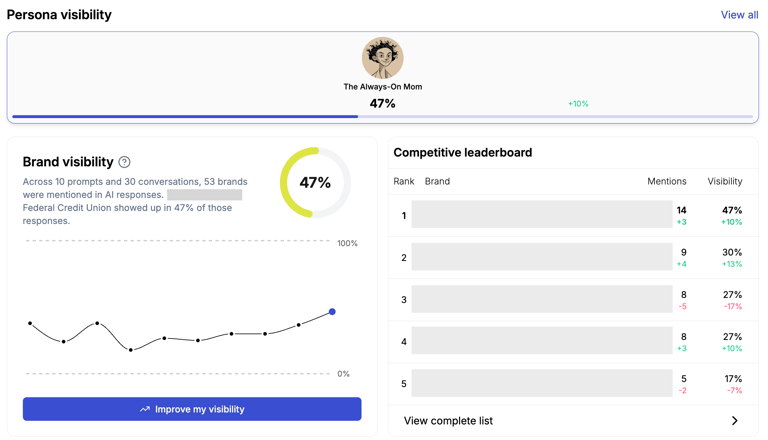
A core differentiator of Gumshoe is how it builds its prompts. Instead of running generic queries, it builds AI-inferred buyer personas with roles, goals, and decision-making context. That lets you see how AI models respond to the questions those specific personas would ask.
As a credit union, that's more meaningful than a one-size-fits-all prompt list, because your membership base isn't just one persona. Even a credit union's individual product offerings have multiple personas. For example, a first-time homebuyer, a small business owner, and a member nearing retirement are all asking AI different questions, even if they’re searching for the same product. Gumshoe's persona reports show you where your credit union is gaining citations (mentions) and where it is losing out to competitors.
Another feature which provides a major advantage for credit unions is Gumshoe supports location targeting down to the city or state level, not just the country. Most tools stop at national visibility, which is not useful for a "credit union in [city]" search. Seeing how your visibility differs between two or more markets you serve is a real advantage, and it's rare in this category.
Here’s what else you get with Gumshoe:
- Visibility tracked across 11 AI models, including Google AI Overviews and Google AI Mode as separate reads
- Up to 5 audit types: Visibility, Sentiment, Citation, Content, and Technical GEO, so you're not just seeing whether you're mentioned, but how, and what's technically blocking AI tools from reading your pages
- A competitive leaderboard tracking up to 30 competitors side-by-side with the ability to only focus on the competitors that really matter
What Gumshoe is not: Gumshoe is a monitoring and diagnostic tool, not a CRM or a full SEO suite. It tells you where you stand and what to fix; it won't connect that data to your member pipeline or your broader search performance on its own.
Get a Free Gumshoe Audit From Geear →
2. HubSpot's AEO Tool
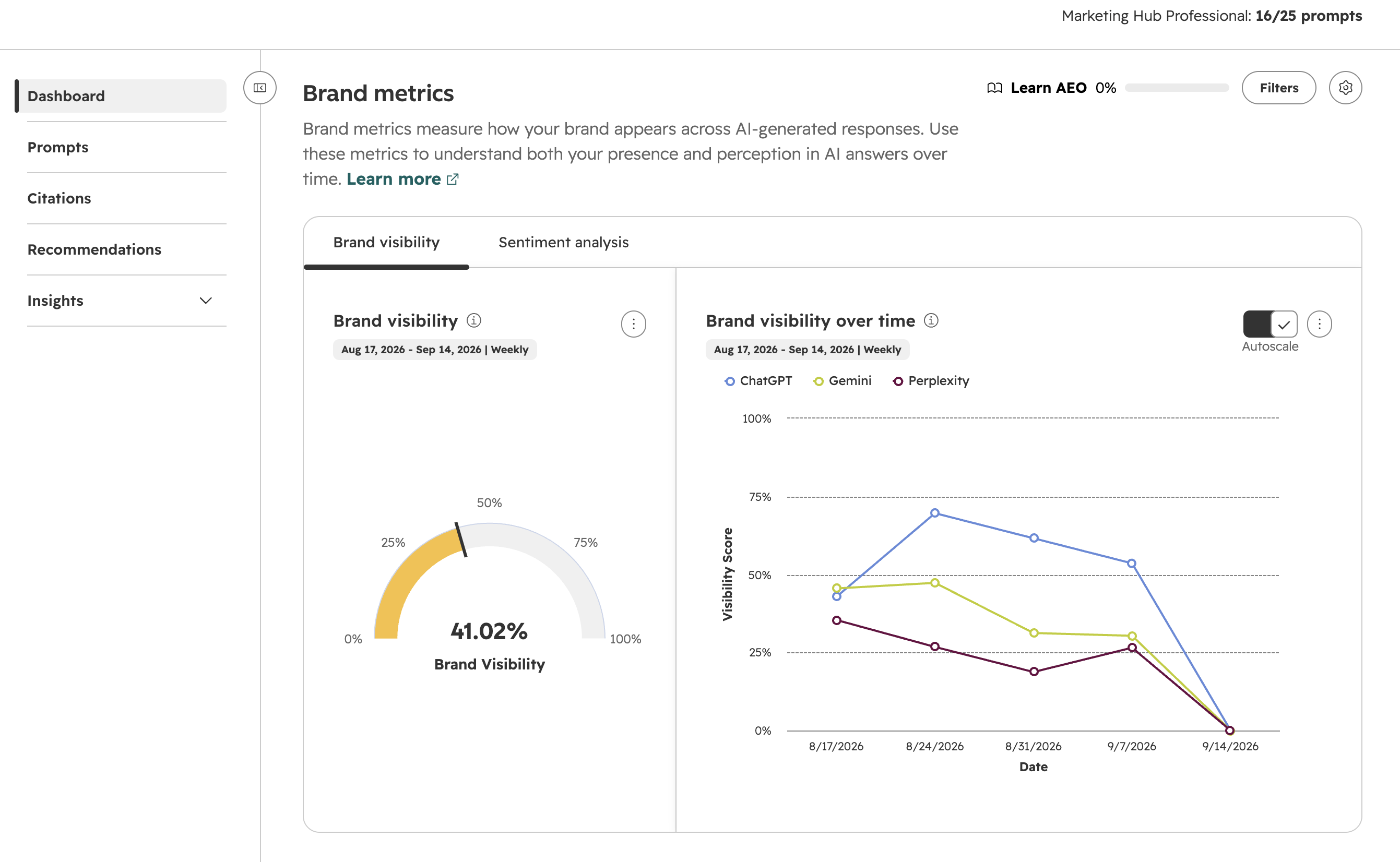
HubSpot's AEO product is newer and currently in beta. It's more limited in scope than Gumshoe as it only tracks visibility across ChatGPT, Gemini, and Perplexity. Those are three of the most popular AI tools used today, but it does fall short compared to Gumshoe's 11 models.
What it offers instead is context. If you're already running Marketing Hub, connecting your CRM data lets HubSpot tighten its recommendations using your actual member and sales activity, not just AI mention counts in isolation. That's a genuinely unique level of tracking: instead of asking "are we mentioned in AI answers," you can start connecting AI visibility to what's happening in your actual pipeline.
Many of the credit unions we work with are already on HubSpot for marketing and lending workflows. The AEO tool lets you add another layer of visibility on top of the system you already use to track members and applications.
What else you get:
- Brand visibility score and share-of-voice tracking against competitors
- Prompt suggestions based on your company, competitors, and industry, rather than starting from a blank list
- Citation analysis showing which domains and pages are showing up in AI answers
- Recommended actions to take, from content updates to off-site PR
- A free trial covering 25 prompts, with deeper functionality tied to Marketing Hub Pro and Enterprise
Where it falls short: Three tracked models is a real limitation next to Gumshoe's 11; you just won't get the same breadth of coverage. However the tool is still in beta, so we expect changes to come. It is also at very reasonable price point and so an easy decision if you're already using HubSpot and want AI visibility tied to CRM data.
Schedule a Free HubSpot AEO Tool Demo →
3. Semrush's AI Visibility Tool
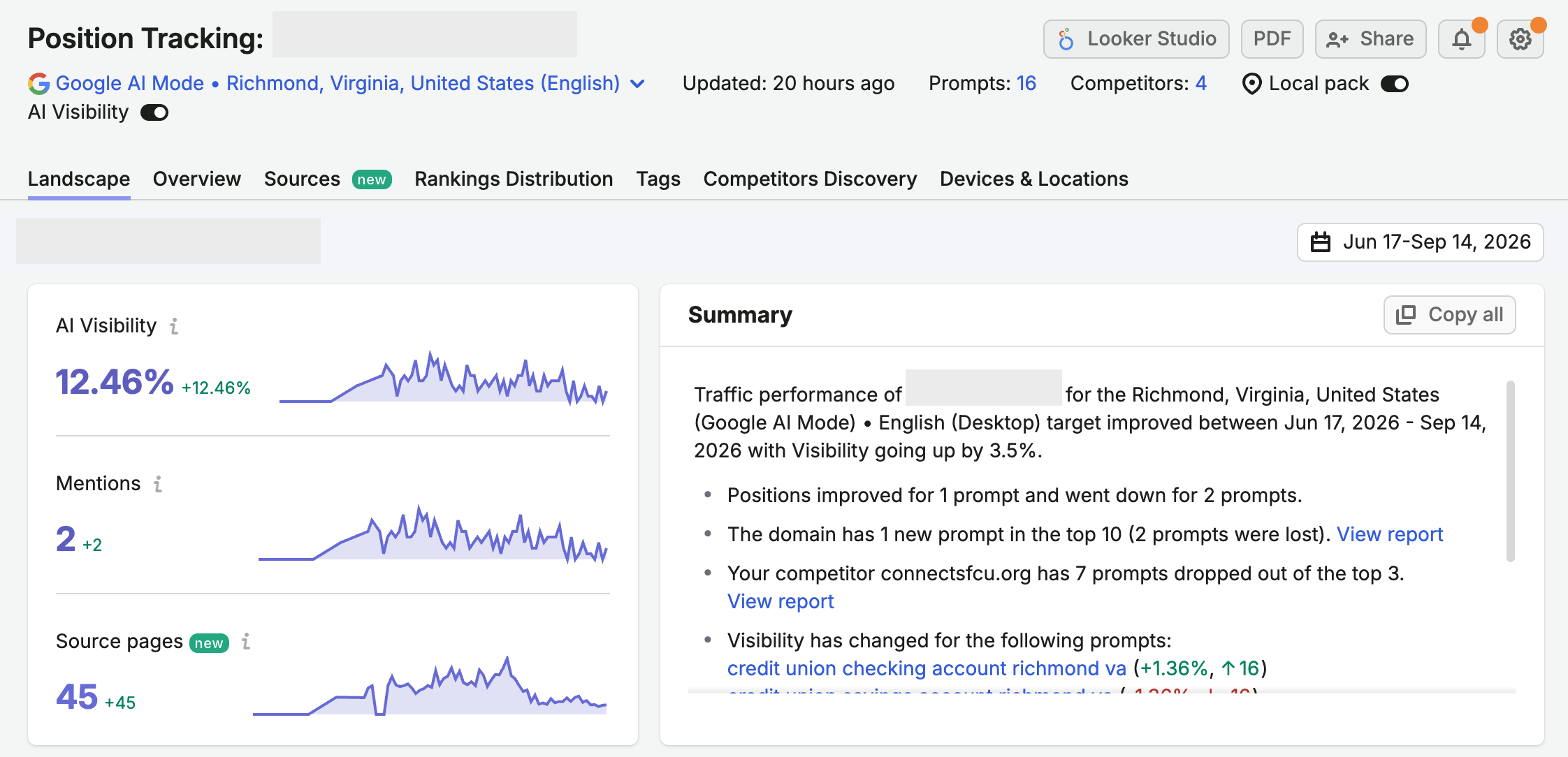
There are two main advatages to Semrush. First, it's one of the few tools that tracks Google AI Mode as a distinct surface, separate from Google AI Overviews, ChatGPT, and Gemini. That distinction matters as a credit union can show up reliably in a regular AI Overview and be nearly invisible in AI Mode for the exact same prompt, because the two features handle content differently.
Second, it's part of a platform many credit union marketing teams (and our teams at Geear) already use for traditional SEO for keyword research, technical site audits, backlink tracking, position tracking, and more. If you're already in Semrush, AI visibility shows up next to the SEO data you're already watching instead of requiring a separate login and a separate mental model.
What else you get:
- Prompt-level tracking across Google AI Mode, AI Overviews, ChatGPT Search, and Gemini, with daily updates
- A Visibility Overview report for quick competitive benchmarking, and Brand Performance reports covering sentiment and the topics AI associates with your brand
- Citation source tracking, so you can see which domains AI models are pulling from in your category
- Side-by-side comparison against a list of competitors you define
What Semrush’s tool is not: The AI Visibility Toolkit is genuinely strongest as an add-on to a broader Semrush subscription and tech stack. If you're not already using Semrush for SEO, you're paying for a full platform to get the AI tracking piece, which is a heavier lift than a purpose-built tool like Gumshoe.
Get a Free Semrush Audit From Geear →
Other GEO tools worth knowing
Gumshoe, HubSpot’s AEO Tool, and Semrush’s AI Visibility Tool are the track GEO tools we use and recommend most often. However here are other names you will see come up if you are researching this space:
- Profound. One of the more established AI visibility platforms, with a strong focus on citation and conversation-level analytics. We've referenced it before in our guide to improving credit union visibility in AI LLMs.
- Ahrefs Brand Radar. Similar logic to Semrush: if you're already running Ahrefs for backlinks and keyword tracking, this adds AI citation tracking to a dashboard you're already using.
- Otterly.ai. A lighter-weight, lower-cost option if you want basic visibility monitoring without a full platform commitment.
We didn't build this list around a fixed ranking. The right tool depends on what you're already running, how many AI models you need visibility into, and whether local geographic data matters to your market (which for most credit unions, it does).
Why this matters for credit unions specifically
More than 50% of Americans now use AI to help with financial decisions, up from just 10% a year earlier, according to TD Bank's 2026 AI Insights Report.
Our own research backs that up at the industry level: in Geear's 2026 Consumer Banking Report, AI tools ranked as the second-most-used research channel for consumers under 45 evaluating financial institutions, trailing only search engines.
Most credit unions are adopting AI internally at a faster clip than banks too, with 59% having deployed generative AI compared to 49% of banks. As part of that surge, credit union chatbot adoption climbed from 3% in 2019 to 46% in 2026, per Cornerstone Advisors and PYMNTS data cited by America's Credit Unions.
But internal AI adoption and external AI visibility are two different problems. Being represented accurately when a prospective member asks ChatGPT or Gemini where to get a car loan is a discoverability challenge, not an operations one. Richard Crone, CEO of Crone Consulting, has argued that most community banks and credit unions are currently losing this battle by default, simply because they don't publish the kind of structured product data AI platforms can find and cite.
That's the gap GEO tools are built to measure. Two things make this a different problem for a credit union than for most brands:
1. You're local by design. AI tools generate different answers depending on geography, and "best credit union in [city]" is a fundamentally different competitive set than "best credit union" nationally. A tool that only tracks visibility at the country level is close to useless for this.
2. Your products are regulated. When an AI tool gets a rate or loan term wrong, that's not a cosmetic error; it's a compliance and trust problem. Tracking how accurately AI describes your products isn't optional the way it might be for a retail brand.
Where to go from here
Picking a tool is the easy part. The harder part, and where most credit unions actually lose ground, is knowing what to do with what it tells you: which prompts to build content around, how to fix the technical issues keeping AI tools from reading your pages correctly, and how to tell the difference between a real visibility gap and noise.
That's the process piece we focus on with our GEO strategy work for credit unions. If you want a second set of eyes on where you currently stand, any of the audits above is a solid place to start.
Talk to one of our GEO experts →

Ready for marketing that actually delivers?
Let's build something measurable together.
 Talk to the Team