
Summarize the points from this blog post with AI




An AI Mode sidebar is rolling out for all users in Google’s Search experience now. This will appear, collapsed by default, before clicking into AI Mode on desktop only.
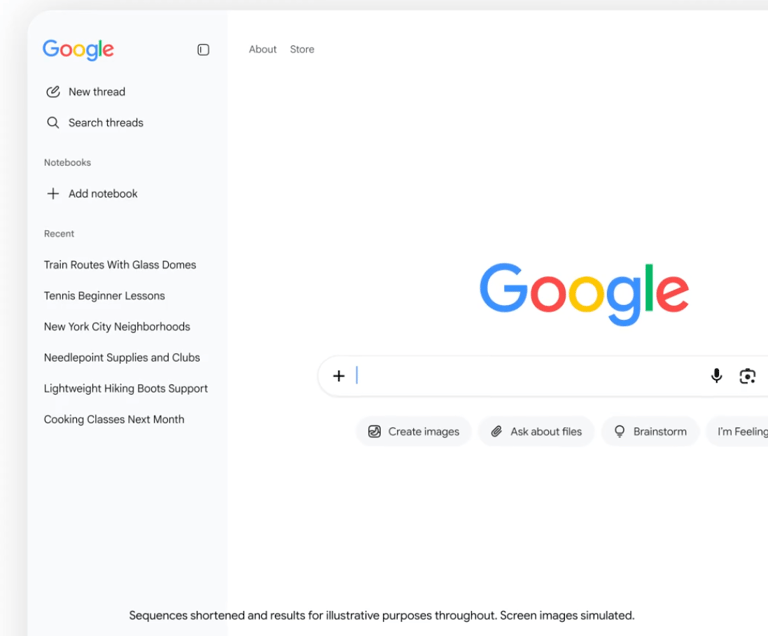
“New on the Google desktop homepage globally: we’re rolling out a collapsible sidebar to easily find & jump back into your recent AI searches.
People are coming to Search with more questions that aren’t just one and done – and in testing, this sidebar made a big difference for making progress & continuing to explore the web.
A much simpler way to pick up where you left off.”
Google's VP of Product for Search, Robby Stein, announced on November 19th via X,
This change doesn’t directly impact rankings and AI Mode is still not Google’s default search experience. But what does change is behavior.
What Exactly Changes With Google’s “Collapsible Sidebar” In Search
Here are the core facts to know about this change:
|
Question |
What we know |
|---|---|
|
Where is this happening? |
All Desktop Google homepage experiences; no mobile version has been announced (Digital Trends) |
|
What's in it? |
New thread, Search threads, a list of recent AI Mode conversations, and Notebooks – it essentially functions like most AI tool sidebars allowing you to pick back up with old and recent chats |
|
Who will see this new search experience? |
Signed-in users with search history saved; rolling out gradually worldwide |
|
What’s its default state? |
It starts off collapsed as a thin bar on the left of the screen (see the image above) until clicked. Once you click an old chat, it moves you into AI Mode to see it |
|
What does it not change? |
Typing a query and pressing Enter still returns regular results (Android Authority) |
This is just one of the latest additions to Google's AI Mode. Google has added an AI Mode button to the search box, follow-up questions from AI Overviews that continue into AI Mode, AI Mode in Chrome, and, on November 17, "temporary threads" that aren't saved to history (eCorpIT).
What Else You Should Know (Or Ignore) About AI Mode In Google Search
Much of what's circulating about AI Mode is still hypothetical or incorrect, so it helps to separate what’s going around into confirmed true, false, or unknown.
|
Claim |
Status |
|---|---|
|
The sidebar exists on the desktop homepage and is rolling out globally |
Confirmed true by Google's Robby Stein. |
|
AI Mode is now Google's default search |
False. A Google spokesperson told Press Gazette on May 26, 2026 that AI Mode is not the default and blue links remain. (eCorpIT summary) |
|
The sidebar lists all your searches, not just AI ones |
True based on limited experience. Google describes it as "recent AI searches"; one outlet said otherwise; we don’t have a clear picture in our testing so we’ll update this when we do have a clear picture. |
|
The sidebar merges your Gemini app chats into Search |
False. Contradicted by Google's help pages: notebook sources sync, chats don't (Google Help). This appears false based on initial testing. |
|
The sidebar has measurably changed traffic |
Unknown. Google published no test data, and no one can measure sidebar use from outside. |
|
The sidebar is coming to mobile or to regular results pages |
Unknown. A results-page version was tested in October (Search Engine Roundtable), nothing announced. |
Google is also still experimenting in both directions. In November, it tested removing the AI Mode tab from some results pages (Search Engine Roundtable). You should expect to see continued, slow or steady movement toward AI answers, not a single switch-over date.
Why This AI Search Sidebar Matters: Research Is Moving Into AI Threads
Multiple studies show that when AI answers appear, people click through to websites less. While most studies agree on this directional shift, they do disagree on the size of the shift.
|
Study |
Method |
Finding |
|---|---|---|
|
Agarwal & Sen, Apr 2026 |
Randomized experiment, 1,065 US desktop users |
AI Overviews cut organic clicks 38%; users sent to AI Mode clicked out least |
|
Pew Research, Jul 2025 |
Browsing panel, 900 adults |
8% clicked a result with an AI summary vs 15% without, a 7% difference |
|
Ahrefs, Feb 2026 |
300,000 keywords, correlational |
Top result's click-through rate 58% lower when an AI Overview shows |
|
Seer Interactive, Apr 2026 |
53 brands, 5.47M queries |
Clicks fell, then partly rebounded; brands cited in the answer got about twice the clicks of uncited ones |
The randomized study by Agarwal & Sen is the strongest evidence because it isolates the cause. The others are useful but correlational or from vendor panels.
A few patterns and opportunities are continuing to develop with this further push into an AI-native search experience:
Informational Questions Lose The Most Clicks When Google Users Use AI
- The pattern: "What is", "How does", and other upper funnel searches are where AI answers most reliably appear and where clicks have fallen the furthest, mostly thanks to AI Overviews. Branded, transactional, "near me" and other more bottom-of-funnel searches are slightly less affected.
- The opportunity: There’s some nuance to this pattern. We’ve seen upper-funnel content get some engagement when it’s comprehensive, genuinely useful, and pointed at real, specific people. While clicks are being lost to AI answers that cover “general knowledge,” specific and unique queries can still drive visibility and engagement. Make sure your lower funnel content is covered but then go ahead and create for upper funnel too in a genuinely useful way.
Being cited in AI Answers Can Help Recovers Clicks Lost From Top Rankings
- The pattern: With AI features (plus ads and other organic SERP features) stealing real estate from top ranking positions, the goal shifts from ranking #1 to being one of the few sources AI Mode names and cites.
- The opportunity: Make sure your content is accessible and easy to read by people and AI tools. Consider structuring your content in a way that’s optimal for snippets; aim for specific and keyword-rich headings, keep sections and paragraphs concise and focused on specific topics and subtopics, and ensure your content can be accessed by AI crawlers.
The New Sidebar Adds A Third Pattern & Opportunity
- The pattern: Research that spans several sessions. Someone comparing options over a week can now return to the same AI thread, so the shortlist forms inside Google before anyone visits a website.
- The opportunity: This makes it even more important to have content that answers questions and provides value at as many points in the customer journey as possible, especially as they get closer to comparing options and choosing a solution. Make sure Google can easily find qualifying details about your brand and offerings. Make sure information about your brand is accurate and consistent across reputable sites online (which Google may pull from to serve answers). And cover as many scenarios along the funnel as you can to offer real value to your audience along their journey.
How To Measure Performance As Google Marches Toward AI-Native Search
The hardest part of digital marketing in this modern era has become tracking it accurately. Google performance falls into that category, and it may be one of the toughest to track. No tool today shows how many visits Google's AI features send you, period. And nothing shows sidebar use. So, what can we see?
Here’s what each tool can and can't see.
|
Tool |
What it shows |
What it can't show |
|---|---|---|
|
GA4, Organic Search channel |
Visits from Google. These do include clicks from AI Overviews and AI Mode, just not segmented out |
Which of those visits came from an AI answer (Google Analytics Help) |
|
GA4, AI Assistant channel |
Visits referred by ChatGPT, Gemini, Claude, Copilot, Perplexity and similar |
Google's AI Overviews and AI Mode, which Google excludes from this channel (Google Analytics Help) |
|
Search Console, Performance report |
All Google clicks and impressions. These do include AI features, just not segmented out |
AI clicks separately from regular clicks |
|
Search Console, Generative AI report |
Impressions in AI Overviews and AI Mode by page, country, device and date (Search Engine Journal) |
Clicks, queries, or an API export |
|
Tools like Semrush, Ahrefs, Profound, Gumshoe |
How your site and brand could show up for specific, synthetic, prompts or in some cases how sites and brands show up in actual searches |
Synthetic prompts can’t show exactly how you’ll show up when personalization and other factors are folded into the search results. |
Two practical consequences follow:
- "AI traffic" in GA4 actually understates reality. It counts ChatGPT and other assistants, not Google's own AI search, which is likely the larger source. But, if we think of AI traffic in GA4 as traffic specifically from AI tools and not from AI features in search then this tracking can at least make sense, even if it doesn’t help give a clear picture.
- Year-over-year impression comparisons are unreliable. Google confirmed a Search Console logging error over-reported impressions from May 13, 2025 to April 27, 2026; clicks were unaffected. The Great Decoupling in late 2025 also adds to the murkiness of impressions in Search Console.
Today’s Workaround Is To Combine Signals
Use a combination of tools and reports to get the best data you can from multiple angles. If one set of data changes drastically, compare that to the other sets of data to understand what’s happening directionally. For example, you might watch Search Console AI impressions by page, GA4 conversions per organic visit, branded search volume, tagged Business Profile links, and even add a "how did you hear about us" question on forms.
Sources And Methodology
Our data. GA4 and Search Console figures, Aug–Oct 2026. Semrush figures in the US database as of November 2026 (Semrush counts are estimates).
Published sources
- Search Engine Roundtable: Google rolls out collapsible sidebar on Search
- Search Engine Roundtable: AI Mode left sidebar test on results pages
- Search Engine Roundtable: Google testing dropping AI Mode tab
- Digital Trends: Google's desktop homepage keeps AI Mode chats on the left
- Android Authority: Google homepage changes
- Google Search Help: Notebooks in AI Mode
- eCorpIT: AI Mode is not the default (Google statement to Press Gazette)
- eCorpIT: AI Mode temporary threads
- Digital Applied: AI Mode passes 1 billion users
- Search Engine Journal: Randomized study finds AI Overviews cut organic clicks 38%
- Pew Research Center: Google users less likely to click with AI summaries
- PPC Land: Ahrefs finds AI summaries take 58% of top-result clicks
- Seer Interactive: 2026 AI Overview CTR research
- Google Analytics Help: Default channel group
- Search Engine Journal: Search Console AI reports rolled out worldwide

Ready for marketing that actually delivers?
Let's build something measurable together.
 Talk to the Team