
Summarize the points from this blog post with AI




There's a line going around SEO circles right now: "Good SEO is good GEO."
It's not wrong...
Much of what we see earning AI citations and recommendations traces back to SEO fundamentals we've practiced for years. But taken at face value, that line invites a dangerous assumption: If your SEO program is already solid, AI visibility just falls into place for free. And that's not totally true.
The "Organic Search" channel has (not so) quietly been splitting into two or more channels. Members are increasingly asking ChatGPT, Gemini, and Perplexity things like "Credit union vs. bank for an auto loan," "Am I eligible to join [credit union]," or "Best HELOC rates near me" before they ever type a query into Google or land on your site.
Whether you show up in that answer depends on work a standard SEO program won't automatically do. Such as auditing your site for AI-specific bot access, building content around how AI actually researches a question rather than how Google ranks one, and actively managing what dozens of third-party sources say about you.
None of that happens passively just because your traditional SEO performance is healthy.
Here's the upside, though: Because this work is built on the same foundation as SEO (Crawlable content, well-structured pages, credible third-party signals), credit unions investing in GEO can actually strengthen your traditional rankings too. It's not a tradeoff between SEO budget and GEO budget. Done right, the same investment does double duty. But it only compounds if someone is actually doing the GEO-specific work, not assuming it's already covered.
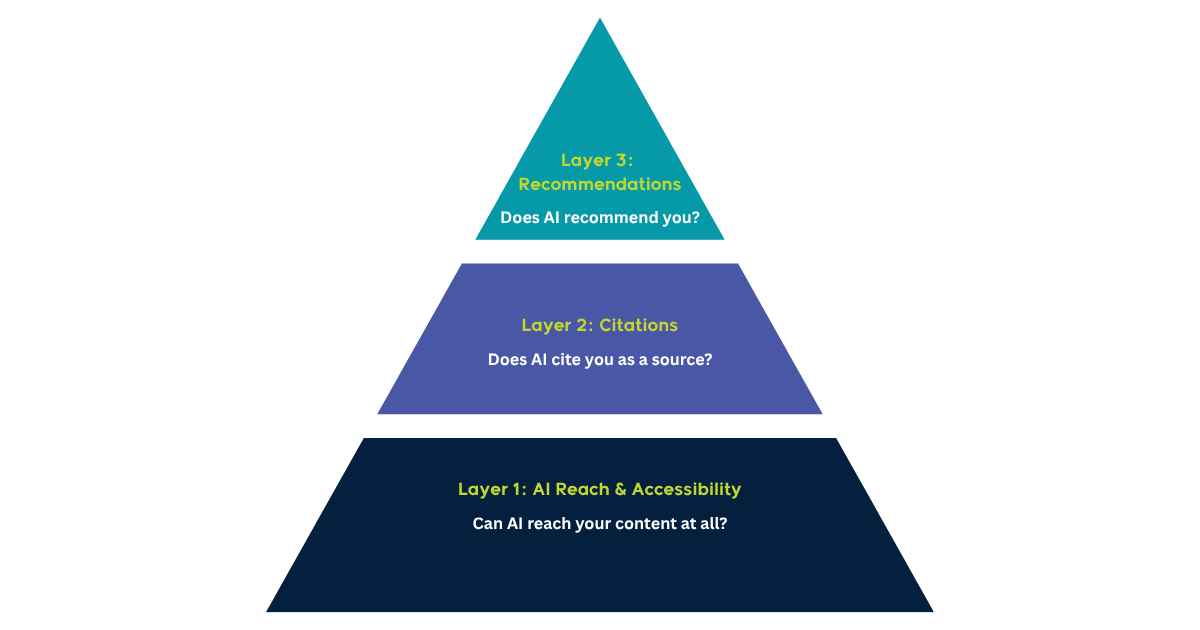
There are three layers to this:
- Can AI reach your content at all? Crawl access and rendering, audited specifically for AI bots, not just Googlebot. We turned this into a standalone AI Accessibility Checklist your team can run through directly.
- Does AI cite you as a source? Content built around how AI actually researches a question, which goes beyond standard keyword targeting.
- Does AI actually recommend you? The layer with the most compounding SEO value and the one most credit unions haven't touched at all.
Here's what each layer looks like in practice.
1. Making Sure AI Can Actually Reach You
This is the layer most people assume is already handled. But for a security-conscious industry like financial services it often isn't. Credit unions run some of the most locked-down web infrastructure on the internet, for good reason. But the same WAF rules and bot-blocking defaults that keep fraud out can also block the AI bots that would otherwise cite you, without anyone realizing it until visibility quietly drops.
The short version: Audit your robots.txt and CDN/bot-management settings specifically for AI crawlers, not just Googlebot; confirm rates pages and loan calculators render without heavy JavaScript; and check that nothing on public-facing pages is accidentally tagged noindex or nosnippet. None of this touches anything behind the online banking login; it's entirely about the public content you already want found.
This part is mechanical enough that your team can run through it directly, which is why we built it out as its own AI Accessibility Checklist rather than folding it into the strategy work below.
2. Winning Citations in AI Search Results
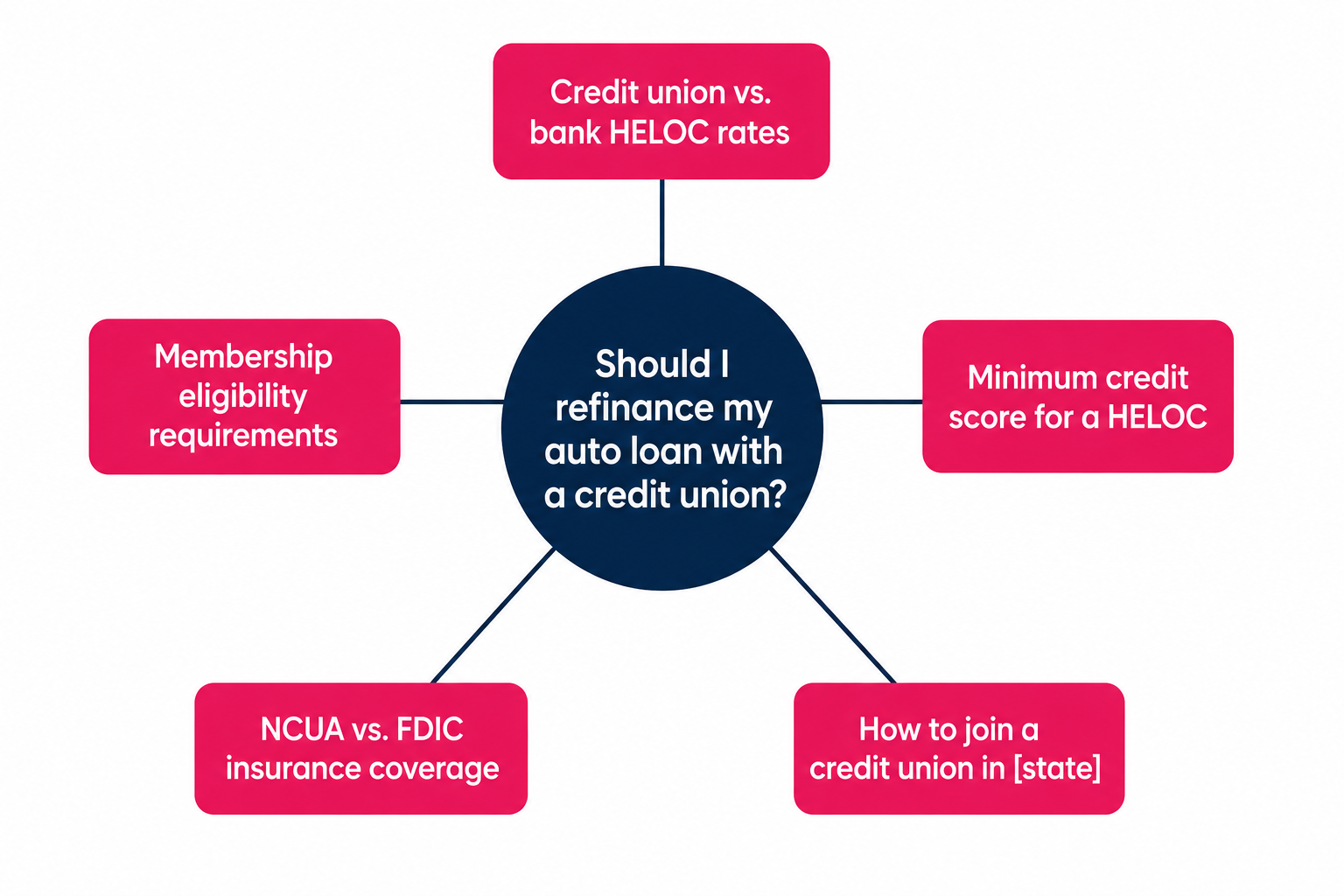
Ranking for "auto loan rates" gets you in the conversation. It doesn't get you cited nearly as often as you'd expect, because AI engines don't just answer the question you typed, they generate a batch of related sub-questions behind the scenes (called fan-out queries) and research all of them before writing an answer.
Ask an AI assistant "should I refinance my auto loan with a credit union," and it's quietly also researching things like:
- Credit union vs. bank HELOC rates
- Membership eligibility requirements
- Minimum credit score for a HELOC
- NCUA vs. FDIC insurance coverage
- How to join a credit union in [state]
There's research evidence (via a ranking method called Reciprocal Rank Fusion) that the more of these fan-out queries you rank for organically, the more likely you are to get cited on the original question, not just the sub-questions.
Example: A single page targeting "HELOC rates" is competing against national comparison sites (Bankrate, NerdWallet, LendingTree) that have already built out content answering all five questions above. One page on one keyword loses that fight. A cluster that answers the adjacent questions a member actually has doesn't.
A few things can make your content a stronger citation candidate:
- Specific numbers, not marketing language. "Competitive rates" gets ignored. A real rate range with a date on it gets cited.
- Unambiguous eligibility criteria. State plainly who can join and how. This is one of the most-asked fan-out questions in financial services, and it's one most CU websites bury or leave vague.
- The NCUA/FDIC distinction, stated precisely. AI models frequently get share insurance vs. deposit insurance slightly wrong or garble the coverage amount. A page that states it cleanly — NCUA insures deposits up to $250,000 per depositor, the same coverage level as FDIC — is exactly the kind of content AI prefers to cite, because it confirms something the model already half-knows rather than introducing a brand-new claim it has to evaluate from scratch.
- Headers phrased as members actually ask them. "HELOC Rates" underperforms "How does a home equity line of credit work at a credit union?" — match the question, not your internal terminology.
Traditional SEO vs Generative Engine Optimization for citations
This isn't work a standard keyword strategy already does. Traditional SEO targets head terms and search volume. Fan-out research targets the tail of specific questions AI assembles behind the scenes, which usually don't show up in a keyword tool at all.
The concept is simple. The execution isn't: finding fan-out queries at scale across dozens of product lines (HELOC, auto, mortgage, business, membership, credit-builder), mapping them against your existing content gaps, and prioritizing which clusters to build first is genuinely research-heavy work that needs to run continuously, not as a one-time content audit.
The SEO dividend shows up as a side effect. A cluster that thoroughly answers eight adjacent questions also tends to outrank a single thin page in traditional search, but it's a byproduct of the GEO work, not a substitute for doing it.
3. Get Recommended in ChatGPT and Other AI Tools, Not Just Cited
Ranking and citations are necessary but not sufficient. AI recommendations lean on something closer to distributed consensus: what the model already knows, what's ranking well, and what multiple independent, trusted sources say about you, all pointing the same direction.
.png?width=1200&height=630&name=Heading%20(1).png)
For a credit union, that consensus gets built from a specific set of many potential sources:
- NCUA's field-of-membership data and Find-a-Credit-Union listing
- Rating and comparison sites like BauerFinancial, DepositAccounts, Bankrate
- Google Business Profile, per branch, not just headquarters
- Local coverage like Chamber of Commerce, local news, community org partnerships
- Member conversation like Reddit (r/personalfinance and local subreddits are where "which credit union should I join" actually gets discussed), local Facebook groups
What matters for GEO more than general SEO
Field-of-membership consistency is the single highest-leverage fact you control. It's binary, either someone can join or they can't, and it's exactly the kind of fact AI will state with false confidence if your sources disagree.
If your homepage says "open to anyone in [county]" and a stale directory listing says "employees of [company] only," an AI assistant can confidently tell a prospective member they're not eligible when they are. That's a lost member, and it's a fixable data-consistency problem, not a content problem.
Specific member stories outperform star ratings. "They helped me refinance my auto loan after a bankruptcy when three banks turned me down" is a claim an AI can extract and cite. "Great service, 5 stars" isn't. If you're collecting reviews, the prompt matters. Ask for the specific problem solved, not just a rating.
Credit unions already have an underused advantage here: community involvement. Financial literacy programs, local sponsorships, scholarship funds; most CUs do this work and treat it as community relations, not marketing. It's actually some of the best digital PR material available, because it generates exactly the kind of authentic, third-party mentions (local news, school district pages, nonprofit partner sites) that build consensus, as opposed to generic backlink outreach that reads as manufactured.
The harder, more technical layer underneath all of this is entity consistency. That means making sure your name, locations, and field-of-membership are represented identically across Google Business Profile, NCUA data, directories, and LinkedIn, and then actively monitoring for drift, since stale third-party listings are usually outside your direct control and only get fixed through active outreach.
That's ongoing monitoring across a dozen-plus surfaces, quarter over quarter, not a project with an end date. It's also, not incidentally, the same clean, consistent entity signal Google rewards in traditional local and organic search, so the outreach you do to fix a stale NCUA listing or claim an unmanaged branch profile pays off twice.
Start Improving Your AI Search Performance Today (And Watch Your Traditional SEO Grow Alongside It)
Start with the AI Accessibility Checklist: It's mechanical and you can run it yourself this week! The citation and recommendation layers are where the real investment is: This isn't a line item you fold into your existing plan and call it covered.
Fan-out research and entity cleanup, done systematically across a full product line is its own body of work, one that happens to lift traditional SEO performance along the way. That's the part Geear gets pulled in for.

Ready for marketing that actually delivers?
Let's build something measurable together.
 Talk to the Team