
Summarize the points from this blog post with AI




The data referenced below is from research conducted by Geear among 1,000 customers on their banking preferences. The survey was conducted end of 2025. The data below is sourced from a Geear study involving 1,000 customers, which investigated their banking preferences. This research was completed at the end of 2025.
Summary:
- Under-45 non-members default to traditional banks for nearly every high-priority factor (customer service, accessibility, branches, variety, community), while online-only banks win the digital experience categories (mobile app, online experience). Credit unions do not lead a single factor in 2022 or 2025 for this segment (per the slide’s “most often rated as best”).
- Credit unions gain ground once someone is already a CU member, but not primary (Non-PFI): in 2025, credit unions become “best” for customer service, and also lead on variety of offerings and financial education. While online-only banks remain “best” for mobile app and online experience.
- Primary credit union relationships (PFI) are strong, but no longer safe: in 2025, online-only banks match credit unions for “best” accessibility and continue to dominate “best” online experience; credit unions still lead most human/community factors.
- Surprising insight: In the Non-PFI segment, traditional banks are rated “least often as best” for mobile app in 2025. A sign that even “big banks” can lose perceived digital leadership if the experience lags or expectations rise.
- The strategic takeaway: Credit union growth in under-45 audiences is a two-front strategy. (1) break the “big bank default” among non-members, and (2) defend PFI members from online-only competitors by upgrading the accessibility and mobile moments that shape everyday satisfaction.
➡️ Click Here to Download the full report now
What the Slide Shows
Segment A: Non-CU Members, Under 45 Years Old
- Traditional banks are “best” (2022 and 2025) for: Customer Service, Accessibility, Local Branches, Variety of Offerings, Community Involvement (and Financial Education in 2025).
- Online-only banks are “best” (2022 and 2025) for: Mobile App, Online Experience.
- Financial Education (2022) shows all three institution types appearing as “best.”
- Credit unions appear as “least often rated as best” for most factors in 2022 and 2025 (mobile app, accessibility, branches, variety, online experience), and also share “least” for customer service (with online-only banks).
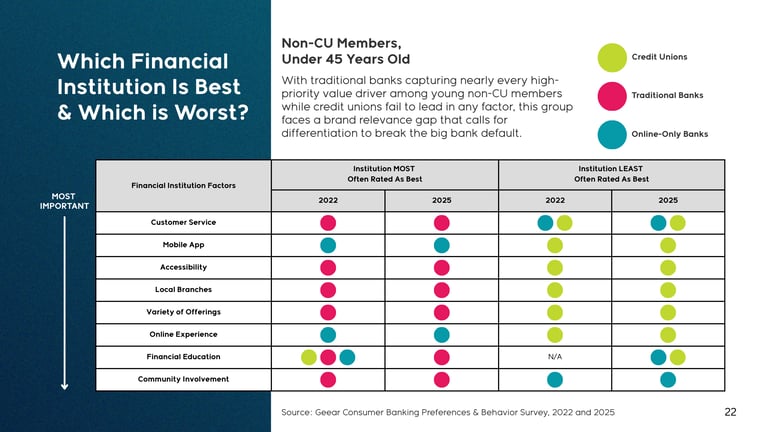
Traditional banks capture nearly every high-priority value driver among young non-CU members, and credit unions fail to lead in any factor. Creating a brand relevance gap that requires differentiation to break the big bank default.
Segment B: CU Members (Non-PFI), Under 45 Years Old
- In 2025, credit unions are “best” for Customer Service (in 2022, both credit unions and traditional banks appear as “best”).
- Online-only banks are “best” for Mobile App and Online Experience (2022 and 2025).
- Traditional banks are “best” for Accessibility and Local Branches (2022 and 2025).
- Credit unions are “best” for Variety of Offerings and Financial Education (2022 and 2025).
- Community Involvement shows credit unions and traditional banks together as “best” (2022 and 2025).
- “Least often rated as best” is dominated by online-only banks across many human/community factors—especially customer service, branches, and community involvement.
%2c%20Under%2045.png?width=768&height=432&name=Q9%20CU%20Members%20(Non-PFI)%2c%20Under%2045.png)
The slide’s callout highlights the opportunity: by displacing traditional banks as top-rated service provider for younger non-primary CU members, credit unions have a foothold to convert them into primary relationships through superior human support.
Segment C: CU Members (PFI), Under 45 Years Old
- In 2025, online-only banks match credit unions as “best” for Accessibility (both appear).
- For Mobile App, credit unions and online-only banks both appear as “best” in 2022 and 2025.
- Credit unions are “best” for Customer Service, Variety of Offerings, Financial Education, and Community Involvement (2022 and 2025).
- Online-only banks are “best” for Online Experience (2022 and 2025).
- “Least often rated as best” is generally: traditional banks for accessibility/mobile/online experience, and online-only banks for branches/customer service/financial education/community.
%2c%20Under%2045.png?width=1920&height=1080&name=Q9%20CU%20Members%20(PFI)%2c%20Under%2045.png)
The slide’s callout warning is clear: if online banks now match credit unions on accessibility, credit unions must differentiate through superior service depth.
Why It Matters for Credit Unions
If you lead growth in a credit union, these three slides describe the funnel you’re actually managing, even if your org chart divides it into “marketing,” “digital,” “branches,” and “member service.”
1) Acquisition risk: Under-45 non-members don’t see credit unions as “best” at anything that matters
This is the core growth constraint. When a segment rates you “least often as best” on mobile app, accessibility, branches, offerings, and online experience, you are not losing because of one campaign. You are losing because your category position is not salient at decision time.
Implication: Your conversion problem begins before the “open account” page. It begins with default choice behavior: “If I need a new account, I’ll go with a big bank.”
2) Expansion opportunity: Non-PFI members are persuadable and already giving credit unions credit for service
Non-PFI members are the highest-leverage segment in the entire report view. They have a relationship (so friction is lower), but they have not consolidated their financial life with you (so wallet share is available).
Implication: Converting Non-PFI to PFI is the most efficient path to near-term growth in deposits, loans, and interchange because you are moving an existing member from “secondary” to “primary,” not trying to win a cold start.
3) Retention risk: PFI under-45 members can still defect in the “everyday moments”
Even when members say credit unions are best for service, education, community, and offerings, they increasingly compare “accessibility” and “mobile” to online-only competitors.
Implication: PFI status is not a loyalty badge; it’s a daily choice reinforced by frictionless access, a strong mobile app, and fast problem resolution.
What’s Driving This Trend
- Digital experiences are structurally owned by online-only banks in these segments: mobile app and online experience repeatedly show online-only banks as “most often rated best.”
- Traditional banks still win “default trust” among non-members across high-priority drivers like customer service, accessibility, branches, and variety.
- Credit unions win human value once a relationship exists (especially customer service in the Non-PFI and PFI segments).
What Geear interprets is happening:
- Visibility + availability bias: Under-45 non-members likely name “traditional banks” because they are the most visible, easiest to recall, and easiest to access at the moment of need.
- Experience signals travel faster than brand promises: App store ratings, login friction, onboarding speed, and support responsiveness create stronger shared narratives than community messaging.
- Stage-of-relationship changes what “best” means: Before joining, people assume “best” = largest and most accessible. After joining, “best” shifts toward service experience, but digital expectations keep rising.
- “Accessibility” is being redefined: The PFI slide suggests online-only banks are now considered equally accessible; accessibility may now mean “can I do it instantly, anywhere,” not “is there a branch nearby” (inference).
Conclusion
For under-45 consumers, “best financial institution” isn’t a fixed label. It changes based on the relationship stage. Traditional banks win the default choice among non-members, online-only banks win the digital experience, and credit unions win the human value once a relationship exists. The opportunity (and risk) is clear: credit unions can grow fastest by converting Non-PFI members to PFI, but they’ll only hold PFI status if they defend the “everyday moments” where accessibility and mobile experience are judged, often against online-only competitors.
Want the full breakdown behind these insights?
Download the Geear Consumer Banking Preferences & Behavior Report to explore the complete findings across 40+ charts, including segment cut views by age and primary financial institution status (PFI vs Non-PFI). So, you can benchmark where your credit union is winning, where you’re exposed, and what to prioritize next.
➡️ Download the full report (and share it internally to align marketing, retail, digital, and member service on a single growth plan).

Ready for marketing that actually delivers?
Let's build something measurable together.
 Talk to the Team